By bypassing the SATA bottleneck, OCZs RevoDrive Hybrid promises transfer speeds up to 910 MB/s and up to 120,000 IOPS 4K random write. The SSD aspect reportedly uses a SandForce SF-2281 controller and the hard drive platters spin at 5,400rpm. On a whole, the hybrid drive makes good use of the companys proprietary Virtualized Controller Architecture.
Good news on the Consumer Electronics front, OCZ continues to innovate on the desktop aftermarket introducing a new PCIe Flash product that marries a nice 1TByte Hard Drive to a 100GB flash-based SSD. The best of both worlds all in one neat little package. Previously you might buy these two devices seperately, 1 average sized Flash drive and 1 spacious Hard drive. Then you would configure the Flash Drive as your System boot drive and then using some kind of alias/shortcut trick have the Hard drive as your user folder to hold videos, pictures, etc. This has caused some very conservative types to sit out and wait for even bigger Flash drives hoping to store everything on one logical volume. But what they really want is a hybrid of big storage and fast speed and that according to the press release is what the OCZ Hybrid Drive delivers. With a SandForce drive controller and two drives the whole architecture is hidden away along with the caching algorithm that moves files between the flash and hard drive storage areas. To the end user, they see but one big Hard drive (albeit installed in one of their PCI card slots), but experience the faster bootup times, faster application loading times. I’m seriously considering adding one of these devices into a home computer we have and migrating the bootdrive and user home directories over to that, using the current hard drives as the Windows backup device. I think that would be a pretty robust setup and could accommodate a lot of future growth and expansion.
Some people may remember the poorly marketed and badly implemented Microsoft ReadyBoost technology hyped prior to the launch of Windows Vista. Microsoft’s intention was to speed throughput on machines without sufficient RAM memory to cache large parts of the Windows OS and shared libraries. By using a small Flash memory module on
Intel Turbo Memory to be used as ReadyDrive storage cache
the motherboard (Intel’s Turbo Memory) or by using a USB connected Flash memory stick one could create a Flash memory cache that would offset the effect of having 512MB or less RAM installed. In early testing done by folks like Anandtech and Tom’s Hardware system performance suffered terribly on computers with more than the 512MB of RAM targeted by Microsoft. By trying to use these techniques to offset the lack of RAM on computers with more than 512MB of RAM the computers ran slower using Vista. I had great hopes ReadyBoost at the time the flash cache method of speeding throughput on a desktop PC was heralding a new early of desktop PC performance. In the end it was all a myth created by the Microsoft marketing department.
Some time has passed since then Vista was released. RAM prices have slowly gone down. Even low end machines have more than adequate RAM installed to run Vista or now Windows 7 (no more machines with 512MB of RAM). The necessity of working around those limits of RAM is unnecessary. However total system level I/O has seen some gains through using somewhat expensive Flash based SSD (solid state disks). Really this is what we have all been waiting for all along. It’s flash memory modules like the ones Intel tried using for it’s ReadyDrive capable Turbo Memory technology. However these were wired into a PCIe controller and optimized for fast I/O, faster than a real spinning hard disk. The advantage over the ReadyBoost was the speed of the PCIe interface connected to the Flash memory chips. Enterprise data centers have begun using some Flash SSDs as caches with some very high end product using all Flash SSDs in their storage arrays. The entry level price though can be daunting to say the least. 500GB SSD disks are the top of the line, premium priced products and not likely to be sold in large quantity until the prices come down.
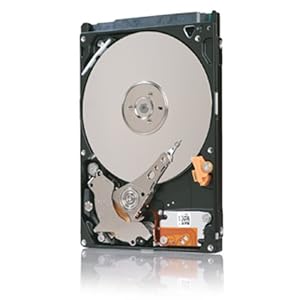
Seagate is now offering a product that has a hybrid Flash cache and spinning disk all tied into one SATA disk controller.
Seagate Momentus XT
The beauty of this design is the OS doesn’t enter into the fray. So it’s OS agnostic. Similarly the OS doesn’t try to be a disk controller. Seagate manages all the details on its side of the SATA controller and OS just sees what it thinks is a hard disk that it sends read/write commands. In theory this sounds like a step up from simple spinning disks and maybe a step below a full flash based SSD. What is the performance of a hybrid drive like this?
As it turns out The Register did publish a follow-up with a quick benchmark (performed by Seagate) of the Seagate Moments XT compared to middle and top of the line spinning hard drives. The Seagate hybrid drive performs almost as well as an the Western Digital SSD included in the benchmark. That flash memory caches the stuff that needs quick access, and is able to refine what it stores over time based on what it is accessed most often by the OS. Your boot times speed up, file read/write times speed up all as a result of the internal controller on the hybrid drive. The availability if you check Amazon’s website is 1-2months which means you and I cannot yet purchase this item. But it’s encourage and I would like to see some more innovation in this product category. No doubt lots of optimization and algorithms can be tried out to balance the Flash memory and spinning hard disks. I say this because of the static ram cache that’s built into the Momentus XT which is 32MBytes in size. Decide when data goes in and out, which cache it uses (RAM or Flash) and when it finally gets written to disk is one of those difficult Computer Science type optimization problems. And there are likely as many answers as there are Computer Scientists to compute the problem. There will be lots of room to innovate if this product segment takes hold.


 Carpet Bomberz Inc.