Ya’ know, there’s a whole world of contract manufacturers out there and the NSA lets them all bid on these. They do not do all this work on their own in house, they like CIA have front companies that go around seeding the ideas, bids, RFPs that eventually lead to these devices. It’s a cottage industry of sorts of small COMMs outfits making small runs of very sophisticated devices. All in the name of National Security.
Author: carpetbomberz
-
Resentment, Jealousy, Feuds: A Look at Intel’s Founding Team – Michael S. Malone – Harvard Business Review

English: Michael S. Malone is a U.S. author, a former editor of Forbes magazine and host of a talk show on PBS. Español: Michael S. Malone es un escritor y guionista estadounidense. (Photo credit: Wikipedia) Just when you think you understand the trio (as I thought I did up until my final interview with Grove) you learn something new that turns everything upside-down. The Intel Trinity must be considered one of the most successful teams in business history, yet it seems to violate all the laws of successful teams.
Agreed, this is a topic near and dear to my heart as I’ve collectively read a number of the stories published over the years from the Tech Press. From Tracy Kidder‘s, Soul of a New Machine, to Fred Brook’s The Miracle Man Month, Steven Levy’s Insanely Great. The story of Xerox PARC as told in Dealer’s of Lightning, the Arpanet Project as told in Where Wizards Stay Up Late. And moving somewhat along those lines, Stewart Brand’s The Media Lab and Howard Rheingold’s Virtual Reality. All of these are studies at some level of organizational theory in the high technology field.
And one thing you find commonly is there’s one charismatic individual that joins up at some point (early or late doesn’t matter) who then brings in a flood of followers and talent that is the kick in the pants that really gets momentum going. The problem is with a startup company say like Intel or its predecessor, Fairchild Semiconductor, there’s more than one charismatic individual. And keeping that organization stitched together even just loosely is probably the biggest challenge of all. So I’ll be curious to read this book Michael Malone and see how it compares to the other books in my anthology of organization theory in high tech. Should be a good, worthwhile read.
Related articles
-

A TV Show About Online Videos Shows Us We’re In A Weird Place With Content Right Now
Unless its broadcast OTA, I’ll never see it. And that’s fine by me as the HD quality I get OTA exceeds the overly compressed digital cable most friends I have pay extra to receive. So I’ll be sitting out this bit of weirdness and pop-culture recursiveness.
-
AMD Clears the Air Around Project FreeSync

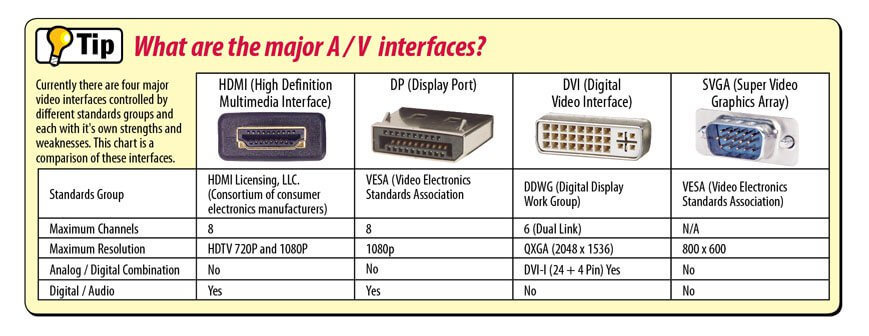
A/V Connectors currently in the market AMD has been making lots of noise about Project FreeSync these past few months, but has also left plenty of questions unanswered.
via AMD Clears the Air Around Project FreeSync.
FreeSync, and nVidia G-sync both are attempting to get better 3D rendering out of today’s graphics cards no matter what part of the market they are aimed at. But like other “features” introduced by graphics card manufacturers there’s a drive now to set a standard common to the manufacturers of cards and hopefully too, the manufacturers of display panels.
Adaptive-Sync is the grail for which AMD is searching, promoting and lobbying for going forward. It’s not too manufacturer specific and is just open enough to be adopted by most folks. The benefits are there too, as the article states Tom’s Hardware has tried out nVidia’s G-sync and it works. Which is reassuring given that sometimes these “features” don’t always appear as big revolutionaries strides in engineering so much as marketing talking points.
AMD has been successful so far in pushing adoption by the folks who make RAMDACs and video scaler circuits for the display manufacturers. That’s the real heavy lifting in driving the standard. And with some slight delays you may see the display panel manufacturers adopt this ActiveSync standard within the next year.
-
A Better Google Glass For $60 (This One Folds)
At $60, this is right-sizing the price for what is essentially a second screen for your smartphone. Take THAT! Google Glass(es). That’s what I’m calling them,… Google Glasses, because that’s what they are. Glasses with a head mounted display.
-
The CompuServe of Things

English: Photo of two farm silos (Photo credit: Wikipedia) Summary
On the Net today we face a choice between freedom and captivity, independence and dependence. How we build the Internet of Things has far-reaching consequences for the humans who will use—or be used by—it. Will we push forward, connecting things using forests of silos that are reminiscent the online services of the 1980’s, or will we learn the lessons of the Internet and build a true Internet of Things?
Phil Windley as absolutely right. And when it comes to Silos, consider the silos we call App Stores and Network Providers. Cell phones get locked to the subsidizing provider of the phone. The phone gets locked to the app store the manufacturer has built. All of this is designed to “capture” and ensnare a user into the cul-de-sac called the “brand”. And it would seem if we let manufacturers and network providers make all the choices this will be no different than the cell phone market we see today.
Related articles
-

Everything You Ever Wanted To Know About Apple’s OS X Yosemite Beta Preview
Looking forward to the next version of Mac OS X? I’m curious to see how well it performs on older graphics card and desktop hardware that’s for sure. As far as User Experience goes and the Interface Design changes, I’m going to hold judgement. As long as everything works as intuitively as the older version I’m fine with that. I don’t care what the icons look like or the title bar or menu bars, none of that really impacts my experience. But speed, and the sense of speed does. I’m hoping the Swift programming language has some big returns on investment for this release of the Desktop OS and we see the iLife Suite slowly migrated into Swift to gain further efficiencies in the use of the graphics accelerator card and the CPU and the SSD.
-
MIT Puts 36-Core Internet on a Chip | EE Times

Partially connected mesh topology (Photo credit: Wikipedia) Today many different interconnection topologies are used for multicore chips. For as few as eight cores direct bus connections can be made — cores taking turns using the same bus. MIT’s 36-core processors, on the other hand, are connected by an on-chip mesh network reminiscent of Intel’s 2007 Teraflop Research Chip — code-named Polaris — where direct connections were made to adjacent cores, with data intended for remote cores passed from core-to-core until reaching its destination. For its 50-core Xeon Phi, however, Intel settled instead on using multiple high-speed rings for data, address, and acknowledgement instead of a mesh.
via MIT Puts 36-Core Internet on a Chip | EE Times.
I commented some time back on a similar article on the same topic. It appears now the MIT research group has working silicon of the design. As mentioned in the pull-quote, the Xeon Phi (which has made some news in the Top 500 SuperComputer stories recently) is a massively multicore architecture but uses a different interconnect that Intel designed on their own. These stories as they appear get filed into the category of massively multicore or low power CPU developments. Most times the same CPUs add cores without significantly drawing more power and thus provide a net increase in compute ability. Tilera, Calxeda and yes even SeaMicro were all working along towards those ends. Either through mergers, or cutting of funding each one has seemed to trail off and not succeed at its original goal (massively multicore, low power designs). Also along the way Intel has done everything it can to dull and dent the novelty of the new designs by revising an Atom based or Celeron based CPU to provide much lower power at the scale of maybe 2 cores per CPU.
Like this chip MIT announced Tilera too was originally an MIT research product spun off of the University campus. Its principals were the PI and a research associate if I remember correctly. Now that MIT has the working silicon they’re going to benchmark and test and verify their design. The researchers will release the verilog hardware description of chip for anyone use, research or verify for themselves once they’ve completed their own study. It will be interesting to see how much of an incremental improvement this design provides, and possibly could be the launch of another Tilera style product out of MIT.
Related articles
-
UK Startup Blippar Confirms It has Acquired AR Pioneer Layar | TechCrunch

Cool Schiphol flights #layar (Photo credit: claudia.rahanmetan) The acquisition makes Blippar one of the largest AR players globally, giving it a powerful positioning in the AR and visual browsing space, which may help its adoption in the mass consumer space where AR has tended to languish.
via UK Startup Blippar Confirms It has Acquired AR Pioneer Layar | TechCrunch.
Layar was definitely one of the first to get out there and promote Augmented Reality apps on mobile devices. Glad to see there was a enough talent and capability still resident there to make it worthwhile acquiring it. It’s true what they say in the article that the only other big name player in this field helping promote Augmented Reality is possibly Oculus Rift. I would add Google Glass to that mix as well, especially for AR (not necessarily VR).
Related articles
-
Doug Englebart’s Grocery List
I’m such a big fan of the Fall Western Joint Computer Conference (FWJCC) 1968 in San Francisco. It was such an awesome production put on.
If you’ve watched the Mother of All Demos, you know that one of the aha! moments of it is when Englebart pulls out his grocery list. The idea is pretty simple –if you put your grocery list into a computer instead of on a notepad, you could sort it, edit, clone it, categorize it, drag-and-drop reorder it.
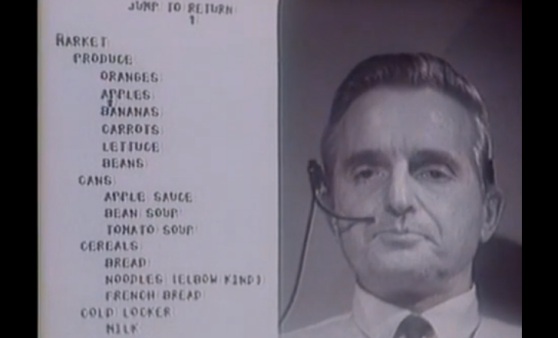
That was 1968. So how are we all doing?
If you’re like my family, there’s probably multiple answers to that, but none particularly good. When Nicole shops, she writes it out on a sheet of paper, and spends a good amount of time trying to remember all the things she has to get. I sometimes write it out in an email I send myself, and then spend time trying to look for past emails I can raid for reminders.
Sorting? Cloning? Drag and drop refactoring?
Ha! What do you think this is, the…
View original post 472 more words




 Carpet Bomberz Inc.