Category: wired culture

Those promoters and bandwagoneers of everything in the Fy00tcha!

  • iPad release imminent – caveat emptor

    Apropos to the big Easter Weekend, Apple is releasing the iPad to the U.S. market. David Pogue from the NYTimes has done two reviews in one. Rather than anger his technophile readers or alienate his average readers he gave each audience his own review of a real hands-on iPad. Where’s Walt Mossberg on this topic? (Walt likes it) Pogue more or less says lack of a physical keyboard is a showstopper for many. Instead, users who need a keyboard need to get a laptop of some sort. Otherwise for what it accomplishes through finger gestures and software design the iPad is a pretty incredible end user experience. Whether or not your personality, demeanor is compatible with the iPad is up for debate. But try before you buy, hand-on will tell you much more than doing a web order and hoping for the best. And given the price, it’s a wise choice. Walt Mossberg too feels you had better actually try to use it before you buy. It is in his own words, not like any other computer but in a different class all its own. So don’t trust other people to tell you whether or not it will work for you.

    One thing David Pogue is also very enthused by is the data plan seems less onerous than the first and second generation iPhone contracts with AT&T. The dam is about to burst on mandatory data plans, and in the iPad universe you can subscribe and lapse, re-subscribe lapse again depending on your needs. So don’t pay for a long term contract if you don’t need it. That addresses a long-standing problem I have had with the iPhone as it is currently marketed by Apple and AT&T. Battery life is another big upshot. The review models that Mossberg and Pogue used had ‘longer’, read that again LONGER run times than stated by Apple. Both guys tried doing real heavy network and video playback on the devices and went over the 10hr. battery life claimed by Apple. Score a big win for the iPad in that category.

    Lastly Pogue hinted at maps looking and feeling like real maps on the bigger display. Mossberg points out the hardware isn’t what’s really important. No, it’s what’s going to show up on the AppStore specifically for the iPad. I think I’ve heard a few M.I.T. types say this before. It’s unimportant what it does. The question is what ‘else’ does it do. And that ‘else’ is the software developer’s coin of the realm. Without developers these products have no legs, no markets outside of the loyal fan base. What may come, no one can tell but it will be interesting times for the iPad owners that’s for sure.

  • Some people are finding Google Wave useful

    Posterous Logo

    I use google wave every single day. I start off the day by checking gmail. Then I look at a few news sites to see if anything of interest happened. Then I open google wave: because thats where my business lives. Thats how I run a complicated network of collaborators, make hundreds of decisions every day and organise the various sites that made me $14.000 in december.
    On how Google Wave surprisingly changed my life – This is so Meta.

    I’m glad some people are making use of Google Wave. After the first big spurt of interest, sending invites out to people interest tapered off quickly. I would login and see no activity whatsoever. No one was coming back to see what people had posted. So like everyone else I stopped coming back too.

    Compare this also to the Facebook ebb and flow. I notice the NYTimes.com occasionally slagging Facebook with an editorial in their Tech News section. Usually the slagging is conducted by someone who I would classify as a pseudo technology enthusiast (the kind that doesn’t back up their files, then subsequently writes about it in an article to complain about it). Between iPhone upgrades and writing up the latest free web service they occasionally rip Facebook in order to get some controversy going.

    But as I’ve seen Facebook has a rhythm of less participation then periods of intense participation. Sometimes it’s lonely, people don’t post or read for months and months. It makes me wonder what interrupts their lives long enough that people stop reading or writing posts. I would assume Google Wave might suffer the same kind of ebb and flow even when used for ‘business’ purposes.

    So the question is, does any besides this lone individual on Posterous use Google Wave on a daily business for work purposes?

    logo
    Google Wave
  • The Eternal Value of Privacy by Bruce Schneier

    Two proverbs say it best: Quis custodiet custodes ipsos? (“Who watches the watchers?”) and “Absolute power corrupts absolutely.”

    via The Eternal Value of Privacy.

    Nobody is the final authority when it comes to monitoring and privacy. No surer example exists than when Stalin died, the rules changed. When the East German state ended the Stazi went away. When the U.S. invaded Iraq, Saddam Hussein fled from power. Those in power try to cleanse their country of all who oppose them (the wrong-thinkers). Then their power evaporates, they vanish and all the rules change again. The same is true of Bush 43.

    George W. Bush was here, now he’s gone. So why not dismantle all that surveillance gear the NSA put into all the network facilities at AT&T, Sprint? The rules have changed, you don’t need to acquiesce to the current administration, because it’s not the same people making the same demands. The rules have changed. Yet as world events on Christmas day have proved there’s always a Jaws-like shark fin rising and falling out there in the ocean. The threat is very close by and we have to be ever vigilant. So the watchers claim of authority is re-established with each and every tragic episode. Still, is a single incident cause for the continued erosion of our rights to privacy? Given the hair-trigger responses we try to architect and instant reprisals it’s obvious to me the current environment proves it can never end, under the current structure. So in order to stop the erosion, we need to change our thinking about the threat. True no one wants to be fearful of flying wherever they may go. And when they go, they don’t want to be faced with having to kill a fellow passenger in order to save themselves, but that’s the situation we have mentally put ourselves in.

    The only way out is to change our thinking. Change how we think about the danger, the threat and you change how much of our freedoms we are willing to give up to respond to the threat. And maybe we can get back to where we once belonged.

  • Google Shrinks Another Market (and I’m not talkin’ DNS)

    Brady Forest writes: Google has announced a free turn-by-turn navigation system for Android 2.0 phones such as the Droid.

    via Google Shrinks Another Market With Free Turn-By-Turn Navigation – O’Reilly Radar.

    And with that we enter a killer app for the cell phone market and the end of the market for single purpose personal navigation devices. Everyone is desperate to get a sample of the Motorola Droid phone to see how well the mix of features work on the phone. Consumer Reports has tried out a number of iPhone navigation apps to see how they measure up to the purpose built navigators. For people who don’t need specific features or generally aren’t connoisseurs of turn-by-turn directions, they are passable. But for anyone who bought early and often from Magellan, Garmin and TomTom the re-purposed iPhone Apps will come up short.

    It's big and heavy but it's got an OS that won't quitThe Motorola Droid however is trying to redefine the market by keeping most of the data in the cloud at Google Inc. datacenters and doing the necessary lookups as needed over the cell phone data network. This is the exact opposite of most personal navigation devices where all the mapping and point of interest data are kept on the device and manually updated through very huge, slow downloads of new data purchased online on an annual basis (at least for me). Depending on the results Consumer Reports gets, I’ll reserve judgment. This is not likely to shift the paradigm currently of personal navigation except that the devices are going to be necessarily even more multipurpose than Garmin has made them. And unwillingly made them at that. The Garmin Nuviphone was supposed to be a big deal. But it’s a poor substitute for a much cheaper phone and more feature filled navigation device. I think the inclusion of Google Maps and Google StreetView is the next big thing in navigation as the Lane assistance differentiated TomTom from Garmin about a year and a half ago. So radical incrementalism is the order of the day still in personal GPS devices. But with an open platform for developing navigation services, who knows what the future may hold. I’m hoping the current oligarchy between Garmin and TomTom starts to crumble and someone starts to eat away  at the low end or even the high end of the market. Something has got to give.
  • 7 Things You Should Know About Google Wave | EDUCAUSE

    Wave challenges us to reevaluate how communication is done, stored, and shared between two or more people.

    logo
    Google Wave

    via 7 Things You Should Know About Google Wave | EDUCAUSE.

    Point taken, since I watched the video of the demo done last spring I too have been smitten with the potential uses of Google Waves. First and foremost it is a communication medium. Second of all unlike email, there are no local, unsynced copies of the text/multimedia threads. Instead everything is central like an old style bulletin board, newsgroup or collaborative wiki. And like a  wiki revisions are kept and can be “Played Back” to see how things have evolved over time. For people recognizing the limits of emailing attachments to accomplish this goal of group editing, the benefits far outweigh the barriers to entry. I was hoping to get an invitation into Google Waves, but haven’t yet received one. Of course if I do get invited, the problem of the Fax Machine will crop up. I will need to find someone else who I know well enough to collaborate with in order to try it out. And hopefully there will be a ready and willing audience when I do finally get an invite.

    As far as how much better is Waves versus email, it depends very much on how you manage your communications already. Are you a telephone person or an email person or a face-to-face person. All these things affect how you will perceive the benefits of a persistent central store of all the blips and waves you participate in. I think Google could help explain things even to us mid-level technilogically capable folks who are still kind of bewildered by what went on in the Demos at Google Developer Day. But this PDF Educause has compiled will help considerably. The analogy I’m using now is the bulletin board/wiki/collaborative document example. Sometimes it’s just easier to understand something in comparison to something you already know/use/understand.

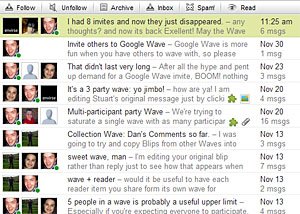
    a list of Google Waves with participant icons
    Waves can start to add up

    PS: Finally got an invite from Google Waves about two weeks ago and went hog wild inviting people to join in. If you want to include me in a Wave add me to your list as: carpetbomberz@googlewave.com. Early returns from sending invites and participating in some experimental Waves has shown the wild popularity dying down quite a bit. At one point we had 8 participants in one single Wave. Trying out some of the add-on tools was interesting too. But the universe of add-ons is pretty small at this point. Hopefully Google will get that third party development effort going in high gear. As far as the utility of the Google Waves, it is way too much like a super-charged glorified bulletin board. It doesn’t have any easy hooks in or out to other Social Media infrastructure. Someone has to make it seamless with Facebook/Twitter/Gmail either though RSS hooks or making the whole framework/interface embeddable or linkable in other websites. As always we’ll see how this goes. They need to keep a torrid pace of development like Facebook achieved from 2005-2007 improving and adding membership to the Google Wave Universe.

  • Bionic Eye

    For those following the announcement of the Apple iPhone 3GS and it’s API for Augmented Reality someone has finally put a killer app into the world for all to use. Finallly all the happiness and promise that is Augmented Reality is now availble on the Apple AppStore. The prototype called Nearest Subway is now called Bionic Eye as told by this article in Wired dot Com:

    Remember the amazing augmented reality application demo for the iPhone that we saw back in July? It was called Nearest Subway, and it overlaid floating representations of nearby New York subway stations onto the live video coming in through the camera of the iPhone 3GS. These appeared to be hanging in space, pinned in place by the 3GS’ compass and GPS.

    That application is now available to buy, for just $1. There have been a few changes – it’s now called Bionic Eye, for instance – but the jaw-dropping virtual signage is still there, and the subway stations have been joined by other points of interest, hotels, fast-food joints and, splendidly, Hooters.

    via Bionic Eye: Augmented iPhone Awesomeness in App Store | Gadget Lab | Wired.com.

  • If You’re Not Seeing Data, You’re Not Seeing | Wired.com

    Wired has an interesting survey of current state of the art in Augmented Reality. They are finally taking notice of this killer app for Smartphones. Let’s hope location data becomes useful worldwide. And let’s hope some enterprising iPhone developers create the Killer App for the iPhone as soon as humanly possible.  There needs to be a mashup with the iPhone video camera, Google Maps and Google Search. All done in a nice seamless iPhone App interface.

    Smartphone Augmented Reality - Simlar to Layar
    What if you could see data?

    Already, developers are creating augmented reality applications and games for a variety of smartphones, so your phone’s screen shows the real world overlaid with additional information such as the location of subway entrances, the price of houses, or Twitter messages that have been posted nearby.

    via If You’re Not Seeing Data, You’re Not Seeing | Gadget Lab | Wired.com.

  • AppleInsider | Apple’s tablet

    Theres no way the tablet will be as hot as the iPhone
    There's no way the tablet will be as hot as the iPhone

    Market projections are a black art. How big is the market for an as yet unreleased product? Marketing departments always have to do the  research and focus groups and test marketing to see what the projections are. But even these can be wrong or misleading. Based on this article one Wall Street analyst firm bases their projections on the market for the Apple TV a niche product if there ever was one. In the first year of it’s production the Apple TV sold 1.2million units. Given the appeal of the iPhone and iPod Touch, the projections are the Mac Tablet will sell far better than the 1.2 million units of the Apple TV. And with a list price of ~$600 US then the revenue generated would be approximately 3% of total revenue. This is all pad on paper estimates based on the up take of a somewhat less successful product, so it could be way off the mark. I’m hoping there’s something new, something nobody has guessed at so far that Apple will include in this device that will help really, really differentiate it. It should be unlike other tablets, and unlike its little brother the iPod Touch.

    We believe an Apple tablet would be priced 30%-50% below the $999 MacBook, and would offer best in class web, email, and media software,” the report reads. “In other words, we believe Apple’s tablet would compete well in the netbook category even though it would not be a netbook.”

    via AppleInsider | Apple’s tablet will be more than a niche product – report.

  • iTunes U: The Beginning

    It’s interesting to see how the whole iTunes U structure works. I’ve been reading documentation about the ‘web services’ enabled within iTunes U. It completely replicates the GUI functions but through a semi-automated interface. Reminds me a little of how you can change the underlying LDAP directory structure using LDIF commands or LDIF files with all the changes embedded within it. In iTunes U, you do an HTTP PUT securely with a signed token, and the iTunes U Web service sucks that up and executes all the commands embedded within your XML file that you put. Very powerful, but very scary too as these changes are made to your production environment. So there’s no real easy way to test the results of your commands without just taking a big risk, leaping in and seeing what happens. This is like SQL commands where you DROP TABLE, not a fun thing to do. DROP TABLE is a big black whole that makes your data disappear in an unrecoverable way. iTunes U has similar functions where you delete the structure AND the data at the same time. You may restore the structure (by backing up your data tree in XML format), but the data embedded within the tree, well that’s gone. So restoring stuff is going to be impossible if you get the syntax wrong in your XML file. The only real benefit to me now is the ability to get a listing of the whole site structure using the Tree command and then forcing an update to any groups that are of the type RSS Feed. The update will be necessary if anyone adds files to a podcast being hosted on servers within our institution.

    I discovered or re-discovered a tool called Woolamaloo which was introduced to me during the Apple iTunes training. University of Illinois Champaign-Urbana created it to allow you to use a GUI to control the Web services from a desktop OS. This is good as I was at a loss to adapt the sample code into anything like a reliable generator of tokens to send to iTunes U web services. I couldn’t figure out what parts of the java example to comment out and recompile. Starting this Monday I’m going to put Woolmaloo through it’s paces. If I can force the RSS feeds to update on demand when somebody has a problem updating their Podcast feeds, I can at least speed things up. But I’m still very leery of deleting or merging any section. I will copy so I can make a course appear in more than one place without using the iTunes multi-click interface. But I will not delete or merge.

    And just today I also discovered there are Apple Automator scripts readily available that add a graphical layer on top of all the web services goodness. So now I can integrate a bunch of steps from uploading bunches of files, forcing RSS feeds to update to merging/rename whole sections all from Automator. I’m going to test it and se how good it really works.

  • Tablet device coming early next year

    True to form, Apple is keeping a tight lid on their Mac Tablet. But all rumors are pointing to a release early in 2010. The announcement of the device may come in September of this year at the point where new iPod products are announced. Other scuttle-butt indicates Verizon may be providing it’s Fourth Generation (4G) network for the new device so that it can stay connected to the Internet wherever Verizon cell phone towers are available. It will be interesting to see how the market might fracture between cell phone and tablet users. I would guess this whole project may turn into an Macintosh Cube experience where Jobs reach exceeded his grasp.

    Tablet & iPhone
    This is how big the 10" tablet might be

    However, the past six months have reportedly seen the critical pieces fall into place. Jobs, who’s been overseeing the project from his home, office and hospital beds, has finally achieved that much-sought aura of satisfaction. He’s since cemented the device in the company’s 2010 roadmap, where it’s being positioned for a first quarter launch, according to people well-respected by AppleInsider for their striking accuracy in Apple’s internal affairs.

    via AppleInsider | Apple’s much-anticipated tablet device coming early next year.