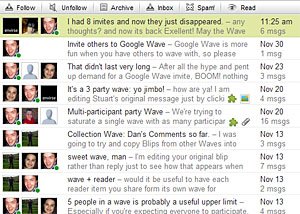
Point taken, since I watched the video of the demo done last spring I too have been smitten with the potential uses of Google Waves. First and foremost it is a communication medium. Second of all unlike email, there are no local, unsynced copies of the text/multimedia threads. Instead everything is central like an old style bulletin board, newsgroup or collaborative wiki. And like a wiki revisions are kept and can be “Played Back” to see how things have evolved over time. For people recognizing the limits of emailing attachments to accomplish this goal of group editing, the benefits far outweigh the barriers to entry. I was hoping to get an invitation into Google Waves, but haven’t yet received one. Of course if I do get invited, the problem of the Fax Machine will crop up. I will need to find someone else who I know well enough to collaborate with in order to try it out. And hopefully there will be a ready and willing audience when I do finally get an invite.
As far as how much better is Waves versus email, it depends very much on how you manage your communications already. Are you a telephone person or an email person or a face-to-face person. All these things affect how you will perceive the benefits of a persistent central store of all the blips and waves you participate in. I think Google could help explain things even to us mid-level technilogically capable folks who are still kind of bewildered by what went on in the Demos at Google Developer Day. But this PDF Educause has compiled will help considerably. The analogy I’m using now is the bulletin board/wiki/collaborative document example. Sometimes it’s just easier to understand something in comparison to something you already know/use/understand.
Waves can start to add up
PS: Finally got an invite from Google Waves about two weeks ago and went hog wild inviting people to join in. If you want to include me in a Wave add me to your list as: carpetbomberz@googlewave.com. Early returns from sending invites and participating in some experimental Waves has shown the wild popularity dying down quite a bit. At one point we had 8 participants in one single Wave. Trying out some of the add-on tools was interesting too. But the universe of add-ons is pretty small at this point. Hopefully Google will get that third party development effort going in high gear. As far as the utility of the Google Waves, it is way too much like a super-charged glorified bulletin board. It doesn’t have any easy hooks in or out to other Social Media infrastructure. Someone has to make it seamless with Facebook/Twitter/Gmail either though RSS hooks or making the whole framework/interface embeddable or linkable in other websites. As always we’ll see how this goes. They need to keep a torrid pace of development like Facebook achieved from 2005-2007 improving and adding membership to the Google Wave Universe.
As reported in Wired.com for Thursday October 15 , 2009. Layar was originally developed in the Netherlands, and runs on Android based cell phones. The first cell phone manufacturer to pre-install it was Samsung who installed it on their Android based Galaxy sold in the Netherlands.
It has now been ported over to the iPhone and will now compete head to head with an early entrant into the AR market, Bionic Eye. Layar had garnered some early mindshare on O’Reilly’s technology blog Radar where I first noticed it. Others had whispered about it early on the cutting edge tech blogs. But this was the first concrete example showing what it could do.
Wired.com has been singing the praises of the cell phone Augmented Reality craze but somewhat later than O’Reilly tapped into it in early Summer. O’Reilly now has a correspondent fully engaged in covering things AR related: Christine Perey. And now let the battle begin Bionic Eye vs. Layar! But first consider the API’s which are already beginning to be examined by the folks over at Wired. One big complaint is the difficulty with which one can submit their own Point of Interest database that Layar can call up. Bionic Eye hasn’t really touted user generated POI content as much. It will take a while to see if it’s the consumers or the developers who determines the winner in the battle for Cellphone AR apps. Who knows? Maybe Google will enter the fray real soon now.
Layar is in the iPhone App Store!
We have waited a long time but it is finally there! Layar arrived in the App Store. It’s free and available globally. Below some screenshots of the App.
I haven’t received my invite yet, but I did sign up. So my fingers are still crossed and I’m hoping I see the invite in my gmail inbox soon. And I some other people I know signed up too, because what’s the use of this exercise if you aren’t collaborating with another person.
In this morning’s blog post, Rasmussen did say there were still some key features missing from Wave that the company has yet to implement. At the moment you can’t remove a friend from a wave, define groups of users or configure the permissions of users on wave. Rasmussen said that they’d be rolling out those features, along with a draft mode and more, over the next few months.
For those following the announcement of the Apple iPhone 3GS and it’s API for Augmented Reality someone has finally put a killer app into the world for all to use. Finallly all the happiness and promise that is Augmented Reality is now availble on the Apple AppStore. The prototype called Nearest Subway is now called Bionic Eye as told by this article in Wired dot Com:
Remember the amazing augmented reality application demo for the iPhone that we saw back in July? It was called Nearest Subway, and it overlaid floating representations of nearby New York subway stations onto the live video coming in through the camera of the iPhone 3GS. These appeared to be hanging in space, pinned in place by the 3GS’ compass and GPS.
That application is now available to buy, for just $1. There have been a few changes – it’s now called Bionic Eye, for instance – but the jaw-dropping virtual signage is still there, and the subway stations have been joined by other points of interest, hotels, fast-food joints and, splendidly, Hooters.
I once believed micro-payments would liberate a number of smaller Internet based ventures. Whether it was bloggers, podcasts or screencasts, DIY videos, someone would pay a fraction of a cent to watch something that really helped them out. But no matter how many people talked or wrote about micropayments, nobody took ownership of it and did anything about it. If it was do-able and profitable somone like PayPal, Google or Yahoo would have done something by now. Smarter and more connected people have gone through the list of reasons why micropayments haven’t worked. And yet, hope springs eternal and some silver tongued soothsayers are promoting micropayments as a solution to the decreased subscriptions for daily news. So just to let everyone know, micropayments will NOT save daily newspapers.
If you want to go back through some of the reams of text that have been written about micropayments for news, Clay’s essay from 2003 is a good place to start — especially since it lists the half-dozen or so attempts to create such a system that failed miserably. (Are you listening, Steve Brill?) There’s also a good roundup at the Freakonomics blog from awhile back that is well worth reading.
Back on July 8th I posted an article talking about the benefits of a new battery technology I had read about on weblog called Technology Review (originally published on June 26th from MIT). It think it may have originally been linked to either Slashdot or The Register. The blog entry was essentially like a press release from a company in California named PolyPlus. They had just announced the project to create single use high energy density Lithium-Air batteries for the military (most likely for radio communications in the field). The key technology was a new way to wrap the lithium cathode in a waterproof seal while still exposing it to the surrounding air encapsulated in the battery. It seems now some other big monied interests have caught onto this new battery chemistry and are going to produce it as well, but maybe not as a single use battery but instead as a rechargeable battery.
IBM is in the news touting the promise of the lithium-air technology as a potential technological nirvana for autmobile drive trains. Estimates are a 10X increase in energy density per kilogram of battery electrolyte material. If this can be achieved, watch out electric vehicles here we come.
Lithium-ion batteries have the potential to deliver about 585 watt-hours of electricity per kilogram, while lithium-sulfur has a theoretical potential of about 2,600 watt-hours, and lithium-air batteries might reach targets well above 5,000 watt-hours.
If they can be perfected, lithium-air batteries would be ideal for transportation applications, given their potential for high energy capacity and low weight. And, unlike zinc-air batteries, it should be possible to make them rechargeable.
It looks like the iPhone OS 3.1 is going to do nothing more the open up the video feed on the camera so that you can overlay data on top of that video. In essence, the Augmented Reality is using your iPhone’s video as a “desktop” picture and placing items on top of that. Acrossair’s iPhone App, Nearest Tube uses the OpenGL libraries to skew and distort that data as you point the camera in different directions, thus providing a little more of a 3D perspective than say something like Layar which I have talked about previously on this blog. Chetan Demani, one of the founders of Acrossair also points out going forward any company making AR type apps will need to utilize existing location information and pre-load all the data they want to display. So the nirvana of just-in-time downloads of location data to overlay on your iPhone video image is not here,… and may not be for a while. What will differentiate the software producers though is the relevancy, and accuracy of their location information. So there will be some room for competition for a quite some time.
He went on to say that it’s pretty simple to do AR applications using the new 3.1 APIs, due out in September. ” It’s a pretty straightforward API. There’s no complexity in there. All it does is it just switches on the video feed at the background. That’s the only API that’s published. All we’re doing is using that video feed at the back. It just displays the video feed as if it’s a live camera feed.
SDXC is yet another memory format all manufacturers will have to adopt. Isn’t it frightening how much the removable memory market has fractured into mico-formats for memory cards. About a week ago I was playing with an Olympus voice recorder at work. It had it’s own funny shaped memory cards you had to buy from Olympus if you wanted to increase the storage size. One positive thing I will say though is this. SDHC at least has consolidated some of the mindshare around a commonly supported form factor for removable storage. Compact Flash once enjoyed a similar amount of support. But nowadays you cannot even find a laptop with CardBus slots anymore. Many add-ons for laptops are installed on internal PCIe busses now.
I hope all the device manufacturers get onboard with the SDXC format only because of the limits on the FileSystem on these cards has needed to adapt to the vagaries of long form video shooting. I remember the painful days of 4GB file size limits for video. That took a long time to dissapate on the desktop computer. It’s high time it disappeared on digital video cameras as well.
Toshiba says all three new cards will bring a maximum write speed of 35 megabytes per second and a read speed of 60 megabytes per second. For videophiles, the new SDXC format will enable video files to extend beyond the current limit of 4 gigabytes.
Apple Insider reports this morning that the TomTom GPS application has appeared in the U.S. AppStore. And if you decided to get the external antenna you can even use your iPod Touch as a GPS. That is way cool and way more useful than I had previously thought this was going to be. Kudos for TomTom to make the thing more widely available on the iPhone platform.
The product works with the iPhone 3G and iPhone 3GS, which include an integrated GPS receiver. It will reportedly also be compatible with the first-generation iPhone and the iPod touch once the separate combo hardware kit is made available. TomTom has not yet announced a price for the hardware package.
There's no way the tablet will be as hot as the iPhone
Market projections are a black art. How big is the market for an as yet unreleased product? Marketing departments always have to do the research and focus groups and test marketing to see what the projections are. But even these can be wrong or misleading. Based on this article one Wall Street analyst firm bases their projections on the market for the Apple TV a niche product if there ever was one. In the first year of it’s production the Apple TV sold 1.2million units. Given the appeal of the iPhone and iPod Touch, the projections are the Mac Tablet will sell far better than the 1.2 million units of the Apple TV. And with a list price of ~$600 US then the revenue generated would be approximately 3% of total revenue. This is all pad on paper estimates based on the up take of a somewhat less successful product, so it could be way off the mark. I’m hoping there’s something new, something nobody has guessed at so far that Apple will include in this device that will help really, really differentiate it. It should be unlike other tablets, and unlike its little brother the iPod Touch.
We believe an Apple tablet would be priced 30%-50% below the $999 MacBook, and would offer best in class web, email, and media software,” the report reads. “In other words, we believe Apple’s tablet would compete well in the netbook category even though it would not be a netbook.”