Blog

  • “Pine Trail”-Intel’s next Atom CPU revision

    In the netbook manufacturing and product development industry, the next big thing is always Intel’s rev of the CPU and chipset. Cue the entry of the Pine Trail CPU and it’s partner I/O Hub chip. Only just this year has Intel shown a willingness to combine functions onto the same processor die. I am very interested to see that the CPU is combining not just the Memory Controller as is the case the top of the line i7 CPU family. Talk about a weight reduction right? The original chipset consisted of no less than 3 processors a North Bridge and South Bridge along with the CPU. Now with the coming of the Pine Trail, it’s a big CPU/GPU/Memory combo and a single I/O hub. I’m hoping the power consumption improves and comes much closer to the proposed specs of the Android based netbooks that will use Smartphone CPUs like Motorola’s or ARM based System-on-Chip custom CPUs. If Intel can combine functions and get battery life for a 3-cell unit to average 8+ hours under even heavy CPU loads, then they will have truly accomplished something. I’m looking forward to the first products to market using the Intel N450, but don’t expect to see them until after Christmas of this year 2009.

    Atom CPU and chipset
    The Intel Atom

    It should use the technology behind Pineview and would be made built on a new, 45 nanometer design that merges the memory controller and graphics directly into the processor; accompanying it would be the new-generation Tiger Point chipset, which is needed for and takes advantage of the N450 design.

    From: MacNN|Electronista
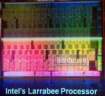
  • More word on Larrabee, the i740 of new GPUs

    Remembering that the Intel Itanium was supposed to be a ground-breaking departure with the past, can Larrabee be all that and more for graphics? Itanium is still not what Intel had hoped. And poor early adopters are still buying new and vastly over-priced minor incremental revs of the same CPU architecture to this day. Given the delays (2011 is now the release date) and it’s size (650mm^2) how is Intel every going to make this project a success. It seems bound for the the Big Fail heap of the future as it bears uncanny resemblances to Itanium and the Intel i740 graphics architecture. The chips is far too big and the release date way to far into the future to keep up with developments at nVidia and AMD. They are not going to stand still waiting for the behemoth to release to manufacturing. I just don’t know how Larrabee is ever going to be successful. It took so long to release the i740, that the market for low end graphics GPUs had eroded to the point where Intel could only sell it for the measly price of $35 per card, and even then no one bought it.

    Larrabee GPU

    According to current known information, our source indicated that Larrabee may end up being quite a big chip–literally. In fact,we were informed that Larrabee may be close to 650mm square die, and to be produced at 45nm. “If those measurements are normalized to match Nvidia’s GT200 core, then Larrabee would be roughly 971mm squared,” said our source–hefty indeed. This is of course, an assumption that Intel will be producing Larrabee on a 45nm core.

    via Intel’s ‘Larrabee’ to Be “Huge” – Tom’s Hardware.

  • links for 2009-06-09

  • links for 2009-06-06

  • My GAF Viewmaster Viewer

    Henry Fonda
    Henry Fonda

    Futurists are all alike. You have your 20th Century types like the Italians who celebrated war. You have Hitler’s architect Albert Speer. You have guys like George Gilder hand waving, making big pronouncements. And all of them use terms like paradigm and cusp as a warning to you slackers, trailers, luddite ne’er-do-wells. Make another entry in your list of predictions for Apple’s Worldwide Developers Conference (WWDC). Everyone feels like Apple has to really top what it’s achieved since last year with the Apple iPhone, the iPhone OS and the AppStore. Mark Sigal writing for O’Reilly Radar believes there’s so much untapped juice within the iPhone that an update in the OS will become the next cusp/paradigm shift.

    From today’s O’Reilly Radar article by Mark Sigal:

    Flash forward to the present, and we are suddenly on the cusp of a game-changing event; one that I believe kicks the door open for 3D and VR apps to become mainstream. I am talking about the release of iPhone OS version 3.0.

    from: 3D Glasses: Virtual Reality, Meet the iPhone – O’Reilly Radar.

    I’m not so certain. One can argue that even the average desktop 3D accelerator doesn’t really do what Sigal would ‘like’ to see in the iPhone. Data overlays is nice, for a 3D glasses kind of application sure, but it’s not virtual reality. It’s more like a glorified heads-up display which the military has had going back to the Korean War. So enter me into the column of the hairy eyeball, critical and suspicious of claims that an OS Update will change things. In fact OSes don’t change things. The way people think about things, that’s what changes things. The move of the World Wide Web from an information sharing utility to a medium for commerce, that was a cusp/paradigm shift. And so it goes with the iPhone and the Viewmaster Viewer. They’re fun yes. But do they really make us change the way we think?

  • links for 2009-06-05

  • Suspenders and a Belt: Tips for backin’ up your Mac

    The Mac has Time Machine built right in
    The Mac has Time Machine built right in

    A co-worker has been working on a reporting tool to allow a Mac user to get reports from Time Machine whenever there’s a failure in the backup. Failure messages occasionally come up when Time Machine runs, but it never says what folder, what file or really what kind of failure occured. Which is not what you want if you are absolutely depending on the data being recoverable via Time Machine. It’s not bulletproof and it will lull you into complacency once you have it up and running. I tend to agree that a belt and suspenders approach is best. I’ve read countless articles saying Disk Clones are the best, and on the other side, Incremental Backups are most accurate (in terms of having the latest version of a file) and more efficient with disk space (no need to duplicate the system folder again right?) With the cost of Western Digital My Books dropping all the time, you could purchase two separate USB2 Lifebooks, use a disk cloning utility for one drive, Time Machine for the other. Then you would have a bullet proof backup scheme. One reader commented in this article that off-site backup is necessary as well, so include that as the third leg of your backup triad.

    Since errors and failure can happen in any backup system, we recommend that if you have the available resources (namely, spare external hard drives) that you set up dual, independent backups, and, in doing so, take advantage of more than one way of backing up your system. This will prevent any errors in a backup system from propagating to subsequent backups.

    One strongly recommended solution that we advocate is to have both a snapshot-based system such as Time Machine in addition to a bootable clone system as well using a software package such as SuperDuper or Carbon Copy Cloner. Doing this will ensure you can both boot and access your most recently changed files in the event of either data loss or hardware failure.

    via MacFixIt

  • Consumer Reports: Sharpen your mower blade

    How to change a lawnmower blade
    How to change a lawnmower blade

    I own a very large metal file, and I use it to sharpen my lawnmower blade. Everything I’ve ever read about sharpening a mower blade indicated you don’t ever use power equipment. By that I mean something that spins at a high rate of speed with a sharpening wheel attached. The reason given is always the same. The steel used in lawnmower blades is hardened along the edges to hold the sharpness longer. When you try to resharpen the blade using a high speed spinning sharpening stone, the metal in the blade heats up. Sometimes it can heat up so much the metal turns color. When you see that color, you have effectively removed the hardening of the steel. It will now be just as soft as a wire coat hanger and not hold the sharp edge for very long. However today I read in Consumer Reports blog that they use a Dremel tool with a blade sharpening attachment. How is this different from your average cheap bench grinder? It’s hand held, but other than that, does it heat up the blade any less? I also have one of the electric drill attachments they mention in the article. I don’t use that tool for the same reason why I probably wouldn’t use the Dremel attachment, it’s going to heat up the blade as the sharpening progresses.

    Another good sharpening option is Dremels Lawn Mower & Garden Tool Sharpener attachment about $8 is. Peter Sawchuk, our outdoor-power-equipment expert, uses this attachment at our mower/tractor-testing site in Fort Myers, Florida, where we check out several dozen models every year. “I see value in the attachment for homeowners,” says Sawchuk, noting that the nylon guide holds the blade at the right angle for maximum sharpness. In Sawchuks experience, the only drawback to the attachment is that it cant grind out major nicks. You can also get similar drill attachments for sharpening a mower blade. Properly clamping the blade in a stationary position and using two hands to guide the tool will help you get a uniformly sharp cutting edge.

    from consumer reports

  • Qualcomm shows Eee PC running Android OS

    Asus Eee PC
    Asus Eee PC

    You wouldn’t think Asus could keep up the blistering pace of development. But here they are once again first to market with a device that uses less power, costs less for the CPU and uses a free OS from none other than Google Inc. What could be better for a bona fide addict of the Google Desktop? Check out the specs on the Snapdragon CPU here.

    If I purchase a netbook at all, this is going to be the one I want just for reading blogs and posting to WordPress. This IS my next computer as far as I’m concerned.

    ” The new laptop — which Qualcomm calls a smartbook — is thinner and lighter than current members of Asustek’s Eee PC netbook lineup because the 1GHz Snapdragon processor that it uses does not require a heat sink or a cooling fan, said Hank Robinson, vice president of business development at Qualcomm.

    Qualcomm’s Snapdragon includes a 1GHz Arm processor core, a 600MHz digital-signal processor and hardware video codecs. Currently, Asustek’s Eee PC line of netbooks relies on Intel processors, in particular the low-cost, low-power Atom chip, which has an x86 processor core.”

    via Good Gear Guide.

  • links for 2009-05-23