Every school of thought wages battles during its reign in order to maintain dominance, to be popular and cool. Most recently Wired.com posted an article indicating Blogs are so 2004. All the ‘cool’ kids had graduated up to Twitter instead. Moving targets being what they are (a barrier to entry) Jeffrey Zeldman took this as a dumb attempt to tastemake at the expense of established bloggers. More specifically it was a misguided attempt to file a provocative story on a short deadline. All the same Zeldman’s negative reaction follows a familiar pattern of righteous indignation, and attempts to question the authority of the author. Ah, History where would we be without ye.
After writing the original blog post about my attempts to read through Learning from Las Vegas I came across a little contoversial nugget near the end of the book. Venturi, Scott Brown and Izenour put a number of proposals for projects and plans in the last third of the book to demonstrate some of the implementation of philosophy they had developed as an architectural and landscape design outfit. Yes, they had learned from Las Vegas, and Levittown. Now they had to show what they learned. In so doing a number of design projects and competitions came up where Requests for Proposals went out and design firms entered into competition.
One of these projects was for a speculative office building just south of the Mall in Washington DC. The group judging submissions was called the Washington DC Fine Arts Commission and ultimately they had final say on the esthetics of any finally chosen design. At this point all is fine and well until Venturi begins to start to complain about the role of Architectural Review Boards or similar bodies like the Fine Arts Commission. Whereas Zoning boards have straightforward rules and laws governing the building site and proposals for buildings on those same sites, all bets are off with the Architectural Review Board. ARB’s and similar purveyors of taste are in Venturi’s opinion not bound by rules, statutes, laws or best practices. Instead the Architectural Review is an Aribtrary Review meant to impress a vague sense of taste and decorum onto something another creative enterprise (the design firm) has placed much effort.
How then can a Review Board who hasn’t a business interest to protect or a legal precedent to uphold have so much power and weild it so clumsily? In the article on this project Venturi went to great pains to explain to members of the Fine Arts Commission that the building’s plan and program were fully agreed upon by his client and in the process money and contracts were being exchanged with lawyers present. These were things hard to undo. But that was immaterial to this review board who proceeded to tear apart the fundamental design and request changes be made for no other reason than to satisfy the whims of the review board. Venturi notes that this is the worst possible situation any architect can find themselves in when it comes to getting things done on schedule and on budget. A review board can severely alter the economics of any project through its request for changes.
That in fact is exactly what happened as the review board met no less than 5 times to look at this one project. Due to scheduling conflicts and members of the review board having other jobs, the schedule can become quite delayed. This affected the budget as costs for materials inflated in price. Similarly, the site plan changed in the middle of the process and robbed the original site of valuable square footage that made the project economically feasible. By the end of the process the project never got built. The actions of a review board helped sink the whole enterprise.
Worse yet, in Venturi’s recollection of the process was the bullying and insults targeted at Venturi’s original design proposal. This brings me to my original reason for writing this article. One prominent member of the Washington DC Fine Arts commission was a big name architect from the illustrious NY City firm of Skidmore Owings and Merril (SOM). This company single-handedly brought the avant garde to the masses in commercial and private buildings the world over. Gordon Bunshaft had broken new ground in the Modern movement or International style of architecture with a number of commissions in Chicago and NYC. He was a genius by all accounts and very well aware of it. Along with this authority came an overarching ego that was going to level all threats to the established order of which he was a part. Enter postmodern architecture in the form of Venturi, Scott Brown & Associates.
Venturi was visible in the publishing arena through articles written for architecture magazines and a few books. He was attempting to question the dominant style that had evolved from Le Corbusier, Walter Gropius, and Ludwig Mies Van der rohe. Throw in Louis I. Kahn, IM Pei and Phillip Johnson and Gordon Bunshaft as the heirs of the mantle of Moderne and now you can see this couldn’t end well for Robert Venturi. Nowhere in the article does Venturi go into any discussion of who Bunshaft is or what he had accomplished up until then. Instead he treats Bunshaft as a sudo faceless bureaucrat appointed to this arbitrary review board. Which makes this all the more impressive as you read Venturi’s account of how mean Bunshaft was through all the precedings of each review board meeting. If Bunshaft didn’t have score to settle with Venturi I would be surprised. The other possibility is maybe Bunshaft hated everything he ever saw in a review board meeting regardless of who the designer was. Here now is a sampling of what Robert Venturi recollects from meetings with the DC Fine Arts Commission back in 1968:
“We felt the overall scheme was greatly improved,” said a letter from the Chairman:
We now look forward to seeing an imaginative development of the architectural expression of the building. Unfortunately, the sketches that we saw showed a very bland and unrelieved treatment of the facade. In fact, there was little difference between the paving pattern and the building itself. Surely the architect can do better than this.
Bunshaft said,
… We disapprove the exterior one hundred percent. We don’t like it at all. It is very coarse, has no character of any sort . . . a sort of nonentity of architecture. I think the indication of signs and things is a deliberate effort to be anti- design, to sort of let everybody have a ball. The grayness of the building, coarseness of joining and detailing — I think you might say we think it is ugly and I think that’s about all we have to say.
Venturi now was defending his right as architect to design the building himself:
At the fourth meeting we tried to show that sophisticated architects had carefully designed the proportions and details of the facade to look ordinary because the extraordinary building in this neighborhood is at the end of Maryland Avenue with a big dome on top.
Aline Saarinen noted that our elevations looked like wallpaper.
Bunshaft continued:
We all listened to [Venturi’s] spiel at the previous meeting. . . . I think the position in a nutshell is for an architect to make a very good building for that site not, in his career, to do a building that is different than the one he did before, or that is different from what is au courant. . . . Remember this is Washington.
So things went all the way to one more full meeting before everyone got tired and just approved the final revision:
[At the fifth meeting we presented the design that passed. It followed the spirit of the law. The Kafkaesque aura, the personal insults, the questionable professional ethics, and the superficial process of review perpetrated by this particular board are revealed in our account of our experience.]
Which brings me to the final last evidence of what transpired. Let’s first start with the original model of the project:
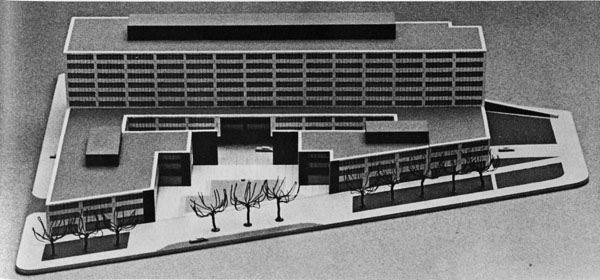
Now let’s see the final submission:
This is an ugly building, the DC Commission of Fine Arts got what they deserved. But luckily for Robert Venturi this thing never got built. Gordon Bunshaft however got his big ugly Concrete Doughnut built right on the Mall to house modern artwork for the Smithsonian Institute. One only need look at the Hirshorn Museum to see the height of what Gordon Bunshaft considers ‘architecture’. In a turn of poetic justice Bunshaft’s own house on Long Island the Travertine House eventually was left to rot by the daughter of none other than Martha Stewart. The historical stature of Bunshaft and his accomplishments held no sway with Ms. Stewart and eventually led to the house being torn down. A fitting legacy ending to a man who dumped all over Robert Venturi during the review period for this project by the DC Fine Arts Commission.


