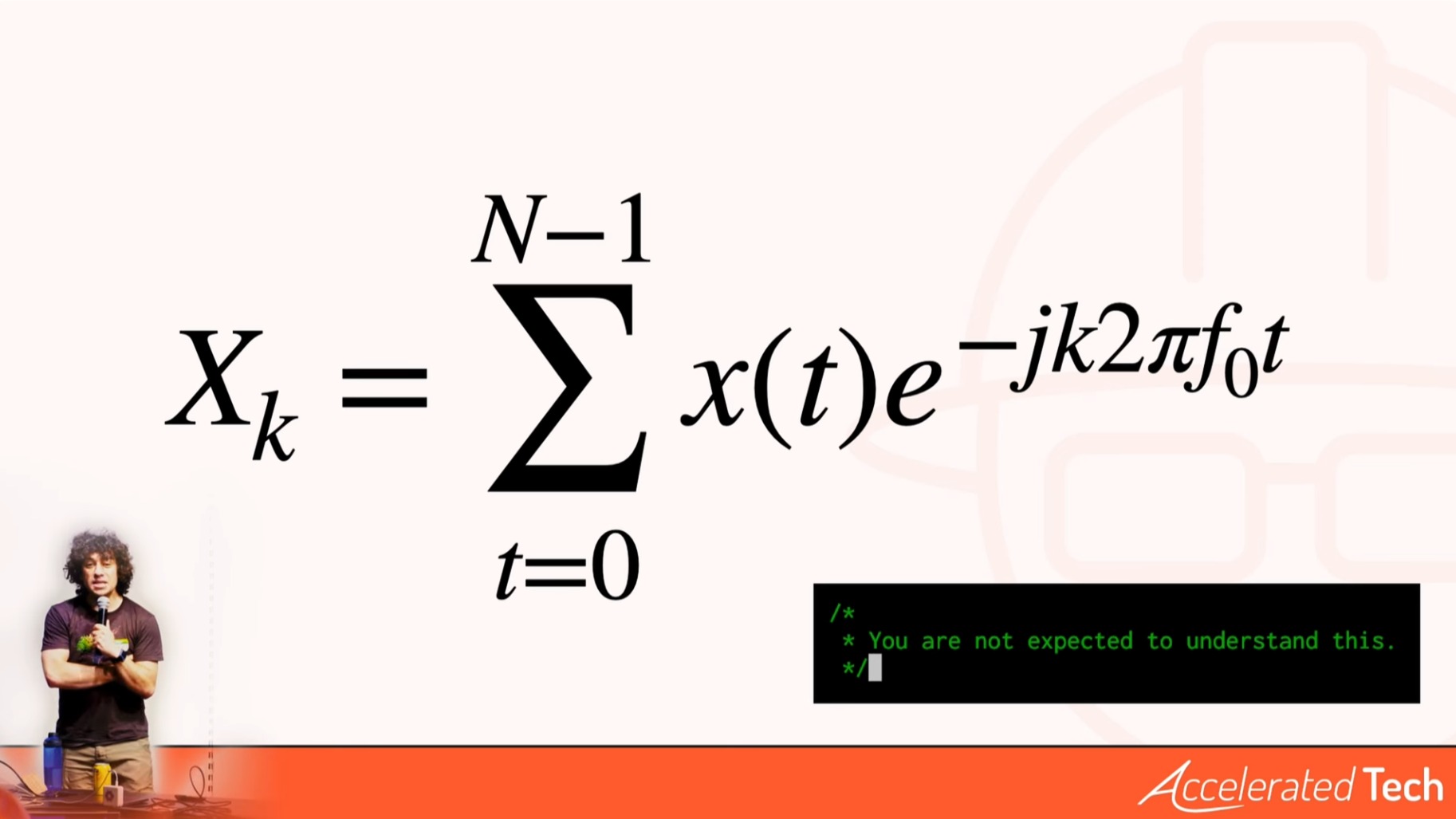
A talk, The Unreasonable Effectiveness of the Fourier Transform, was presented by [Joshua Wise] at Teardown 2025 in June last year. Click-through for the notes or check out the video …read more
Will be checking this out real soon now, as I keep bumping into FFT in different contexts professionally and personally. Some of it is parking ba k to the SETI@home days watching it chug through a data packet like it was a bitcoin proof of work transaction and verification. Those were the daze 🥴.
So @cogdogblog did a nice write-up over the hidden utility of WordPress’s free ActivityPub free plugin which effectively makes your WordPress site a standalone ActivityPub node of one’s own. Like your own instance of Mastodon where you can both 1.)Originate and 2.)Share postings using the ActivityPub protcols same as any other Federated social sharing site. That’s located here: https://cogdogblog.com/2026/01/free-bonuses-wordpress-activitypub-plugin/
The test example Alan (cogodog) used was a Christmas posting by Andy Rush. So here now I’m going to give it a shot myself cobbling together as much of the steps as Alan outline in his article. Let’s see if it Pubs:
That’s nothing more than a new paragraph block with the raw url pasted in. And something I’ve suspected all along (again without confirmation, I’ve asked but it was never clear) there’s 2 tiers of “free” ActivityPub plugin. There’s WordPress.com (free tier) which I have. And then there’s the WordPress.org (non-free hosted tier) which allows you the luxury of editing the look/feel CSS styles of your whole site to your hearts content. And allows you to install actual plug-ins (free or paid ones, that’s on you). The WordPress dot com, free tier doesn’t give you that. You do not get to edit the CSS-styles, look and feel, nor do you get the to add-in any plug-in you desire.
Hence, this is why I’m calling this the acid test. If Andy’s Christmas greeting is not majickally embedded. Then the free-tier WordPress.com site is not using the same ActivityPub plug-in, but a stripped down version that allows WordPress to push a link to your linked ActivityPub account on the instance where it resides (arguably a “nice” feature but nothing like the invention of fire).
So there’s free ActivityPub plug-in, and the stripped down, barely there Plug-in that is just posting a link to your blog into your ActivityPub account when you hit Publish, in order to share the link with your followers. Which is I’m positive all I have access to:
No joy,… sad. Andy’s URL is nothing more than a link. No majickal embed, no ActivityPub goodness. So just be sure you know what you HAVE. There’s ActivityPub (providing links to things) and then ActivityPub (where your blog becomes an ActivityPub instance with all the same capabilities as a full-up Mastoodon site). WordPress.com (free tier) is not that, even though it superficially makes it seem like ActivityPub capability is THERE, it’s just URL links out from your blog post, no oEmbeds or goodness.
I count myself lucky to have indulged back inna day, on Saturday morning cartoons. And specfiically ABC’s rebrand attempt aka One Saturday Morning. That was a whole suite of shows that started just around 9am and ran until 11am with an interesting mix of stuff in between and attempts to really engage with the viewing audience that would make them brand loyal to ABC.
Anyone remember “Manny the Uncanny”. A recurring character in a funny suit and with a funny accent that was hard to place. This guy had many mis-adventures and stunts along the way. But the real star of the show was an import from Canada, known as ReBoot. A 3d rendered cartoon that ran for a number of episodes and had some interesting characters and plot points. The idea was not dissimilar from TRON in some ways where the characters were parts of an overall computer operating system with jobs associated with users from the outside occasionally launching games that the would take over part of the city map in which they would dwell.
It was definitely interesting and there’s not been much before or after that were like it either a true Canadian original. Very much up there like,… I dunno Norman McLaren perhaps?! Worthwhile and I hope to see the full rez resetorations of those Sony D1 archive tapes. Hopefully they will get rights-cleared and see the light of day.
I think this is working. I don’t use WordPress as a means of originating longer form posts on ActivityPub. But I am certain I do have this hooked up correctly as it cross-posts to ActivityPub in past and likely will do it now. But I’ve never tried writing a block of text sufficiently long to override the limits of the Mastodon host where my mastodon account lives. Time now to go for a drive, shall we?!
Okay as I recall I bump into the 500 char. limit but not very often. So if doing a cross-post from WP to Mastodon.online allows me the freedom to write EVEryThInG completely without concision or self-editing, I’m all for that. And maybe a featured image or two. Turns out Dave only got 4 responses to his Google Survey, but I wasn’t sure if he meant cross-posting where you have money to pay for the ACTUAL Activity Pub plug-in or the base level connection you get with the **free** WP.com account. ‘Cuz that’s what I’ve got. Free as in beer, but I have to allow WP to insert adverts into my postings. And they very well may do that here if I type long enough. But that’s worthy of testing and again, I’m all about measuring things and road-testing them too.
If it is the case I can override the char. limit by using WordPress.com to cross-post without the Pay For ActivityPub plug-in you can bet I will post a lot more from this here WP.com account that’s for sure. Now I notice that WP.com allows me to pre-view this post in various sundry pre-viewers like a.)Desktop b.)Tablet and c.)Mobile. But now there’s also Email? and Fediverse too? But when I try Fediverse preview it gives me this sad uninformative error:
And I “feel like” this may be due to the fact I’m on the free WP.com plan and am not using the pay-for ActivityPub plug-in. And I think NOW, my word count is well over the limit of my chosen Mastodon host. (1000+ chars.)
So if you click on the video embedded in this little story, you’ll see there’s a section much later in the program at approximately: 57:22, where Carl Sagan commands “Slide!”
And that my friends is the Neil Armstrong moment. Carl gets to show the first attempt at collecting a “family portrait” of all the planets in the Solar System,but most particularly at that distance Voyager 1 was at, looking backward toward the Sun (not an easy shot to get). But more to the point at the end after he ruminates about the Pale Blue Dot photograph, Carl has some details, and thanks to give out.
See Carl fought a good fight for almost 10 years to get a photo of the Earth from either of the Voyager probes. And none of the scientists/staff managining either mission, NOR Nasa itself wanted to waste valuable time on something so superficial or frivolous or self-centered as an image of Earth from out on the edges of the Solar System. And every time that Carl got shot down, he would try, try again. Until the scientists/staffers finally ran out of actual “Science” they could do on Voyager 1. So they put it through the process of making it an official observation, got it on the schedule.
But man, they hat cut it close. They were right on the hairy edge of missing out, being to far away, in the wrong position to get a usuable image. But they got went throught processes, all the official channels. And Carl thanks each of the 3 JPL staffers who went to bat, and supported the celestial family portrait images, including then head of NASA, Richard Truly. It took NASA and JPL staffers to get that celestial family portrait done. But more to the point, the thing Sagan and his wife Ann really wanted,… that portrait of the Earth way out in the darkness of the Universe.
So enjoy the press conference. It was a celebration for its time. And Voyager 1 still keeps going and going and going.
Bryan and Adam have been gushing for months over Character Limit, the fantastic book by Kate Conger and Ryan Mac about Elon Musk’s haphazard and disastrous takeover of Twitter. They’re joined by the authors themselves to discuss the book, Musk, DOGE, and some of the Character Limit unreleased B-sides.In addition to Bryan Cantrill and Adam…
Talking Dough and Eating Doughnuts. It’s 1 part personal savings/finance, 1 part fun with your daily planner and always a review of locally made vegan doughnut (or sometimes 2 doughnuts!)
Well worth the time spent. And I am always, always in the chat with all the other folks. 4:39 Pacific, 7:39 Eastern Standard Time. You won’t be disappointed.
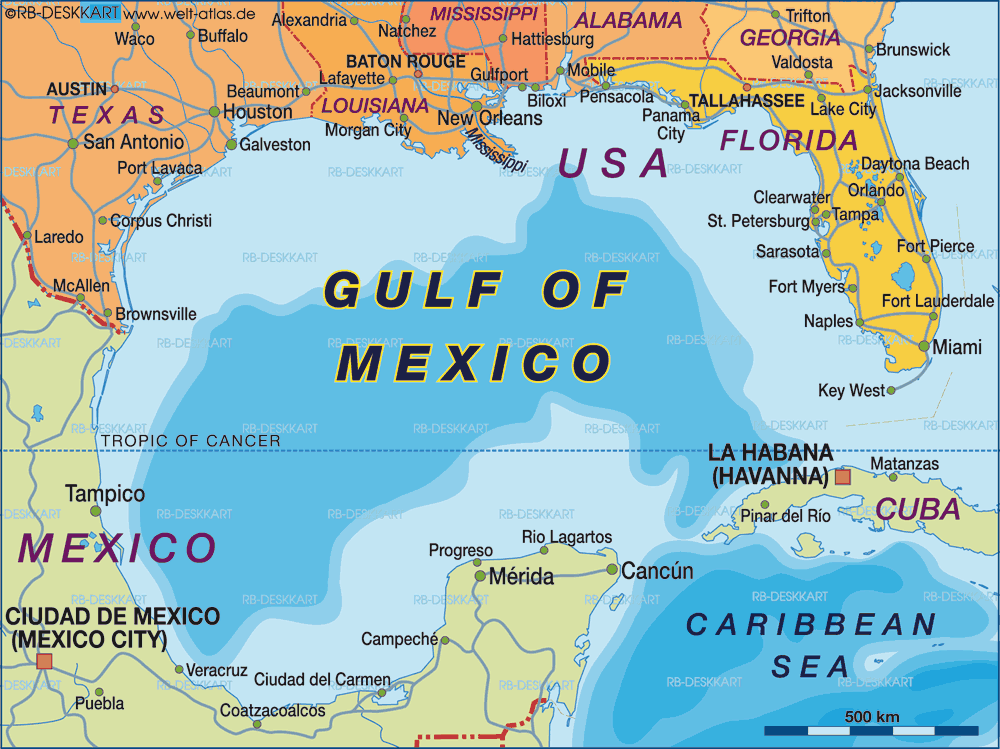
Your favorite free map provider may lie to you. Your GPS even may lie. But I will not lie. I’m not paid to lie, or lying to suck up to Daddy, to avoid government interference or worse “regulation”. No here it is, the truth, both plain and simple.
It is what it is, what it has been, and always will be. The Gulf of Mexico.


 Carpet Bomberz Inc.