Tag: ssd

  • OCZ’s RevoDrive Preview: An Affordable PCIe SSD – AnandTech

    We have seen a turnaround however. At last year’s IDF Intel showed off a proof of concept PCIe SSD that could push 1 million IOPS. And with the consumer SSD market dominated by a few companies, the smaller players turned to building their own PCIe SSDs to go after the higher margin enterprise market. Enterprise customers had the budget and the desire to push even more bandwidth. Throw a handful of Indilinx controllers on a PCB, give it a good warranty and you had something you could sell to customers for over a thousand dollars.

    via OCZ’s RevoDrive Preview: An Affordable PCIe SSD – AnandTech :: Your Source for Hardware Analysis and News.

    Anandtech does a review of the OCZ RevoDrive. A PCIe SSD for the consumer market. It’s not as fast as a Fusion-io, but then it isn’t nearly as expensive either. How fast is it say compared to a typical SATA SSD? Based on the benchmarks in this review it seems as though the RevoDrive is a little faster than most SATA SSDs, but it also costs about $20 more than a really good 120GB SSD. Be warned that this is the Suggest Retail price, and no shipping product yet exists. Prices may vary once this PCIe card finally hits the market. But I agree 100% with this quote from the end of the review:

    “If OCZ is able to deliver a single 120GB RevoDrive at $369.99 this is going to be a very tempting value.”

    Indeed, much more reasonable than a low end Fusion-io priced closer to $700+, but not as fast either. You picks your products, you pays yer money.

  • Seagate, Toshiba to Make SSD + HDD Hybrid?

    Seagate, Toshiba to Make SSD + HDD Hybrid?.

    Some people may remember the poorly marketed and badly implemented Microsoft ReadyBoost technology hyped prior to the launch of Windows Vista. Microsoft’s intention was to speed throughput on machines without sufficient RAM memory to cache large parts of the Windows OS and shared libraries. By using a small Flash memory module on

    Intel Turbo memory module for PCIe
    Intel Turbo Memory to be used as ReadyDrive storage cache

    the motherboard (Intel’s Turbo Memory) or by using a USB connected Flash memory stick one could create a Flash memory cache that would offset the effect of having 512MB or less RAM installed. In early testing done by folks like Anandtech and Tom’s Hardware system performance suffered terribly on computers with more than the 512MB of RAM targeted by Microsoft. By trying to use these techniques to offset the lack of RAM on computers with more than 512MB of RAM the computers ran slower using Vista. I had great hopes ReadyBoost at the time the flash cache method of speeding throughput on a desktop PC was heralding a new early of desktop PC performance. In the end it was all a myth created by the Microsoft marketing department.

    Some time has passed since then Vista was released. RAM prices have slowly gone down. Even low end machines have more than adequate RAM installed to run Vista or now Windows 7 (no more machines with 512MB of RAM). The necessity of working around those limits of RAM is unnecessary. However total system level I/O has seen some gains through using somewhat expensive Flash based SSD (solid state disks). Really this is what we have all been waiting for all along. It’s flash memory modules like the ones Intel tried using for it’s  ReadyDrive capable Turbo Memory technology. However these were wired into a PCIe controller and optimized for fast I/O, faster than a real spinning hard disk. The advantage over the ReadyBoost was the speed of the PCIe interface connected to the Flash memory chips. Enterprise data centers have begun using some Flash SSDs as caches with some very high end product using all Flash SSDs in their storage arrays. The entry level price though can be daunting to say the least. 500GB SSD disks are the top of the line, premium priced products and not likely to be sold in large quantity until the prices come down.

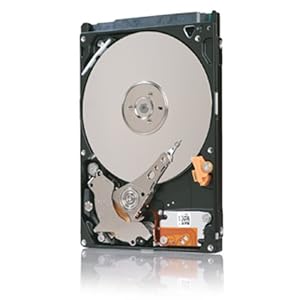
    Seagate is now offering a product that has a hybrid Flash cache and spinning disk all tied into one SATA disk controller.

    Seagate hybrid hard drive
    Seagate Momentus XT

    The beauty of this design is the OS doesn’t enter into the fray. So it’s OS agnostic. Similarly the OS doesn’t try to be a disk controller. Seagate manages all the details on its side of the SATA controller and OS just sees what it thinks is a  hard disk that it sends read/write commands. In theory this sounds like a step up from simple spinning disks and maybe a step below a full flash based SSD. What is the performance of a hybrid drive like this?

    As it turns out The Register did publish a follow-up with a quick benchmark (performed by Seagate) of the Seagate Moments XT compared to middle and top of the line spinning hard drives. The Seagate hybrid drive performs almost as well as an the Western Digital SSD included in the benchmark. That flash memory caches the stuff that needs quick access, and is able to refine what it stores over time based on what it is accessed most often by the OS. Your boot times speed up, file read/write times speed up all as a result of the internal controller on the hybrid drive. The availability if you check Amazon’s website is 1-2months which means you and I cannot yet purchase this item. But it’s encourage and I would like to see some more innovation in this product category. No doubt lots of optimization and algorithms can be tried out to balance the Flash memory and spinning hard disks. I say this because of the static ram cache that’s built into the Momentus XT which is 32MBytes in size. Decide when data goes in and out, which cache it uses (RAM or Flash) and when it finally gets written to disk is one of those difficult Computer Science type optimization problems. And there are likely as many answers as there are Computer Scientists to compute the problem. There will be lots of room to innovate if this product segment takes hold.

  • Disk I/O: PCI Based SSDs (via makeitfaster)

    Great article and lots of hardcore important details like drivers and throughput. It’s early days yet for the PCI based SSDs, so there’s going to be lots of changes and architectures until a great design or a cheap design begins to dominate the market. And while some PCIe cards may not be ready for the Enterprise Data Center, there may be a market in the high end gamer fanboy product segment. Stay Tuned!

    Disk I/O: PCI Based SSDs The next step up from a regular sata based Solid State Disk is the PCIe based solid state disk. They bypass the SATA bottleneck and go straight through the PCI-Express bus, and are able to achieve better throughput. The access time is similar to a normal SSD, as that limit is imposed by the NAND chips themselves, and not the controller. So how is this different than taking a high end raid controller in a PCIe slot and slapping 8 or 12 good SSDs o … Read More

    via makeitfaster

  • PCIe based Flash caches

    Let me start by saying Chris Mellor of The Register has been doing a great job of keeping up with the product announcements from the big vendors of the server based Flash memory products. I’m not talking simply Solid State Disks (SSD) with flash memory modules and Serial ATA (SATA) controllers. The new Enterprise level product that supersedes SSD disks is a much higher speed (faster than SATA) caches that plug into the PCIe slots on rack based servers. The fashion followed by many data center storage farms was to host large arrays of hot online, or warm nearly online spinning disks. Over time de-duplication was added to prevent unnecessary copies and backups being made on this valuable and scarce resource. Offline storage to tape back-up could be made throughout the day as a third tier of storage with the disks acting as the second tier. What was first tier? Well it would be the disks on the individual servers themselves or the vast RAM memory that the online transactional databases were running on. So RAM, disk, tape the three tier fashion came into being. But as data grows and grows, more people want some of the stuff that was being warehoused out to tape to do regression analysis on historical data. Everyone wants to create a model for trends they might spot in the old data. So what to do?

    So as new data comes in, and old data gets analyzed it would seem there’s a need to hold everything in memory all the time, right? Why can’t we just always have it available? Arguing against this in corporate environment is useless. Similarly explaining why you can’t speed up the analysis of historical data is also futile. Thank god there’s a technological solution and that is higher throughput. Spinning disks are a hard limit in terms of Input/Output (I/O). You can only copy so many GBits per second over the SATA interface on a spinning disk hard drive. Even if you fake it by copying alternate bits to adjacent hard drives using RAID techniques you’re still limited. So Flash based SSDs have helped considerably as a tier of storage between the the old disk arrays and the demands made by the corporate overseers who want to see all their data all the time. The big 3 disk storage array makers IBM/Hitachi, EMC, and NetApp are all making hybrid, Flash SSD and spinning disk arrays and optimizing the throughput through the software running the whole mess. Speeds have improved considerably. More companies are doing online analysis to data that previously would be loaded from tape to do offline analysis.

    And the interconnects to the storage arrays has improved considerably too. Fibre Channel was a godsend in the storage farm as it allowed much higher speed (first 2Gbytes per second, then doubling with each new generation). The proliferation of Fibre Channel alone made up for a number of failings in the speed of spinning disks and acted as a way of abstracting or virtualizing the physical and logical disks of the storage array. In terms of Fibre Channel the storage control software offers up a ‘virtual’ disk but can manage it on the storage array itself anyway it sees fit. Flexibility and speed reign supreme. But still there’s an upper limit to the Fibre Channel interface and the motherboard of the server itself. It’s the PCIe interface. And evenwith PCIe 2.0 there’s an upper limit to how much throughput you can get off the machine and back onto the machine. Enter the PCIe disk cache.

    In this article I review the survey of PCIe based SSD and Flash memory disk caches since they entered the market (as it was written in The Register. It’s not a really mainstream technology. It’s prohibitively expensive to buy and is going to be purchased by those who can afford it in order to gain the extra speed. But even in the short time since STEC was marketing it’s SSDs to the big 3 storage makers, a lot of engineering and design has created a brand new product category and the performance within that category has made steady progress.

    LSI’s entry into the market is still very early and shipping product isn’t being widely touted. The Register is the only website actively covering this product segment right now. But the speeds and the density of the chips on these products just keeps getting bigger, better and faster. Which provides a nice parallel to Moore’s Law but in a storage device context. Prior to the PCIe flash cache market opening, SATA, Serial Attached Storage (SAS) was the upper limit of what could be accomplished with even a flash memory chip. Soldering those chips directly onto an add-on board connected directly to the CPU through the PCIe 8-Lane channel is nothing short of miraculous in the speeds it has gained. Now the competition between current vendors is to build one off, customized setups to bench test the theoretical top limit of what can be done with these new products. And this recent article from Chris Mellor shines a light on the newest product on the market the LSI SSS6200. In this article Chris concludes:

    None of these million IOPS demos can be regarded as benchmarks and so are not directly comparable. But they do show how the amount of flash kit you need to get a million IOPS has been shrinking

    Moore’s law holds true now for the Flash caches which are now becoming the high speed storage option for many datacenters who absolutely have to have the highest I/O disk throughput available. And as the sizes and quantity of the chips continues to shrink and the storage volume increases who knows what the upper limit might be? But news travels swiftly and Chris Mellor got a whitepaper press release from Samsung and began drawing some conclusions.

    Interestingly, the owner of the Korean Samsung 20nm process foundry has just taken a stake in Fusion-io, a supplier of PCIe-connected flash solid-state drives. This should mean an increase in Fusion-io product capacities, once Samsung makes parts for Fusion using the new process

    The new Flash memory makers are now in an arms race with the product manufacturers. Apple and Fusion-io get first dibs on the shipping product as the new generation of Flash chips enters the market. Apple has Toshiba, and Fusion-io gets Samsung. In spite of LSI’s benchmark of 1million IOPs in their test system, I give the advantage to Fusion-io in the very near future. Another recent announcement from Fusion-io is a small round of venture capital funding that will hopefully cement its future as a going concern. Let’s hope their next generation caches top out at a size that is competitive with all its competitors and that its speed is equal to or faster than currently shipping product.

    Outside the datacenter however things are more boring. I’m not seeing anyone try to peer into the future of the desktop or laptop and create a flash cache that performs at this level. Fusion-io does have a desktop product currently shipping mostly targeted at the PC gaming market. I have not seen Tom’s Hardware try it out or attempt to integrate it into a desktop system. The premium price is enough to make it very limited in its appeal (it lists MSRP $799 I think). But let’s step back and imagine what the future might be like. Given that Intel has incorporated the RAM memory controller into its i7 cpus and given that their cpu design rules have shrunk so far that adding the memory controller was not a big sacrifice, Is it possible the PCIe interface electronics could be migrated on CPU away from the Northbridge chipset? I’m not saying there should be no chipset at all. A bridge chip is absolutely necessary for really slow I/O devices like the USB interface. But maybe there could be at least on 16x PCIe lane directly into the CPU or possibly even an 8x PCIe lane. If this product existed, a Fusion-io cache could have almost 1TB storage of flash directly connected into the CPU and act as the highest speed storage yet available on the desktop.

    Other routes to higher speed storage could even be another tier of memory slots with an accompanying JEDEC standard for ‘storage’ memory. So RAM would go in one set of slots, Flash in the other. And you could mix, match and add on as much Flash memory as you liked. This potentially could be addressed through the same memory controllers already built into Intel’s currently shipping CPUs. Why does this even matter or why do I think about it at all? I am awaiting the next big speed increase in desktop computing that’s why. Ever since the Megahertz Wars died out, much of the increase in performance has been so micro incremental that there’s not a dime’s worth of difference between any currently shipping PC. Disk storage has reigned supreme and has becoming painfully obvious as the last link in the I/O chain that has stayed pretty static. Parallel ATA migration to Serial ATA has improved things, but nothing like the march of improvements that occurred with each new generation of Intel chips. So I vote for dumping disks once and for all. Move to 2TByte Flash memory storage and let’s run it through the fastest channel we can onto and off the CPU. There’s not telling what new things we might be able to accomplish with the speed boost. Not just games, not just watching movies and not just scientific calculations. It seems to me everything OS and Apps both would receive a big benefit by dumping the disk.

  • Which way the wind blows: Flash Memory in the Data Center

    STEC Zeus IOPs solid state disk (ssd)
    This hard drive with a Fibre Channel interface launched the flash revolution in the datacenter

    First let’s just take a quick look backwards to see what was considered state of the art a year ago. A company called STEC was making Flash-based hard drives and selling them to big players in the enterprise storage market like IBM and NetApp. I depends solely on The Register for this information as you can read here: STEC becalmed as Fusion-io streaks ahead

    STEC flooded the market according to The Register and subsequently the people using their product were suddenly left with a glut of product using these Fibre Channel based Flash Drives (Solid State Disk Drives – SSD). And the gains in storage array performance followed. However the supply exceeded the demand and EMC is stuck with a raft of last year’s product that it hasn’t marked up and re-sold to its current customers. Which created an opening for a similar but sexier product Fusion-io and it’s PCIe based Flash hard drive. Why sexy?

    The necessity of a Fibre Channel interface for the Enterprise Storage market has long been an accepted performance standard. You need at minimum the theoretical 6GB/sec of FC interfaces to compete. But for those in the middle levels of the Enterprise who don’t own the heavy iron of giant multi-terabyte storage arrays, there was/is now an entry point through the magic of the PCIe 2.0 interface. Any given PC whether a server or not will have open PCIe slots in which a

    Fusio-io duo PCIe Flash cache card
    This is Fusion-io's entry into the Flash cache competition

    Fusion-io SSD card could be installed. That lower threshold (though not a lower price necessarily) has made Fusion-io the new darling for anyone wanting to add SSD throughput to their servers and storage systems. And now everyone wants Fusion-io not the re-branded STEC Fibre Channel SSDs everyone was buying a year ago.

    Anyone who has studied history knows in the chain of human relations there’s always another competitor out there that wants to sit on your head. Enter LSI and Seagate with a new product for the wealthy, well-heeled purchasing agent at your local data center: LSI and Seagate take on Fusion-io with flash

    Rather than create a better/smarter Fibre Channel SSD, LSI and Seagate are assembling a card that plugs into PCIe slot of a storage array or server to act as a high speed cache to the slower spinning disks. The Register refers to three form factors in the market now RamSan, STEC and Fusion-io. Because Fusion-io seems to have moved into the market at the right time and is selling like hot cakes, LSI/Seagate are targeting that particular form factor with it’s SSS6200.

    LSI's PCIe Flash hard drive card
    This is LSI's entry into the Flash hard drive market

    STEC is also going to create a product with a PCIe interface and Micron is going to design a product too. LSI’s product will not be available to ship until the end of the year.  In terms of performance the speeds being target are comparable between the Fusion-io Duo and the LSI SSS6200 (both using single level cell memory). So let the price war begin! Once we finally get some competition in the market I would hope the entry level price of Fusion-io (~$35,000) finally erodes a bit. It is a premium product right now intended to help some folks do some heavy lifting.

    My hope for the future is we could see something comparable (though much less expensive and scaled down) available on desktop machines. I don’t care if it’s built-in to a spinning SATA hard drive (say as a high speed but very large cache) or some kind of card plugging into a bus on the motherboard (like the failed Intel Speed Boost cache). If a high speed flash cache could become part of the standard desktop PC architecture to sit in front of monstrous single hard drives (2TB or higher nowadays) we might get faster response from our OS of choice, and possible better optimization of reads/writes to fairly fast but incredibly dense and possibly more error prone HDDs. I say this after reading about the big charge by Western Digital to move from smaller blocks of data to the 4K block.

    Much wailing and gnashing of teeth has accompanied the move recently by WD to address the issue of error correcting Cycle Redundancy Check (CRC) algorithms on the hard drives. Because 2Terabyte drives have so many 512bit blocks more and more time and space is taken up doing the CRC check as data is read and written to the drive. A larger block made up of 4096 bits instead of 512 makes the whole thing 4x less wasteful and possibly more reliable even if some space is wasted to small text files or web pages. I understand completely the implication and even more so, old-timers like Steve Gibson at GRC.com understand the danger of ever larger single hard drives. The potential for catastrophic loss of data as more data blocks need to be audited can numerically become overwhelming to even the fastest CPU and SATA bus. I think I remember Steve Gibson expressing doubts as to how large hard drives could theoretically become.

    Steve Gibson's SpinRite 6
    Steve Gibson's data recovery product SpinRite

    As the creator of the SpinRite data recovery utility he knows fundamentally the limits to the design of the Parallel ATA interface. Despite advances in speeds, error-correcting hasn’t changed and neither has the quality of the magnetic medium used on the spinning disks. One thing that has changed is the physical size of the blocks of data. They have gotten infinitesimally smaller with each larger size of disk storage. The smaller the block of data the more error correcting must be done. The more error-correcting the more space to write the error-correcting information. Gibson himself observers something as random as cosmic rays can flip bits within a block of data at those incredibly small scales of the block of data on a 2TByte disk.

    So my hope for the future is a new look at the current state of the art motherboard, chipset, I/O bus architecture. Let’s find a middle level, safe area to store the data we’re working on, one that doesn’t spontaneously degrade or is too susceptible to random errors (ie cosmic rays). Let the Flash Cache’s flow, let’s get better throughput and let’s put disks into the class of reliable but slower backing stores for our SSDs.

  • 64GBytes is the new normal (game change on the way)

    Panasonic SDXC flash memory card
    Flash memory chips are getting smaller and denser

    I remember reading announcements of the 64GB SDXC card format coming online from Toshiba. And just today Samsung has announced it’s making a single chip 64GB flash memory module with a built-in memory controller. Apple’s iPhone design group has been big fans of the single chip large footprint flash memory from Toshiba. They bought up all of Toshiba’s supply of 32GB modules before they released the iPhone 3GS last Summer. Samsung too was providing the 32GB modules to Apple prior to the launch. Each Summer newer bigger modules are making for insanely great things that the iPhone can do. Between the new flash memory recorders from Panasonic/JVC/Canon and the iPhone what will we do with the doubling of storage every year? Surely there will be a point of diminishing return, where the chips cannot be made any thinner and stacked higher in order to make these huge single chip modules. I think back to the slow evolution and radical incrementalism in the iPod’s history going from 5GB’s of storage to start, then moving to 30GB and video! Remember that? the Video iPod @ 30GBytes was dumbfounding at the time. Eventually it would top out at 120 and now 160GBytes total on the iPod classic. At the rate of change in the flash memory market, the memory modules will double in density again by this time next year, achieving 128GBytes for a single chip modules with embedded memory controller. At that density a single SDHC sized memory card will also be able to hold that amount of storage as well. We are fast approaching the optimal size for any amount of video recording we could ever want to do and still edit when we reach the 128 Gbyte mark. At that size we’ll be able to record 1080p video upwards of 20 hours or more on today’s video cameras. Who wants to edit much less watch 20 hours of 1080p video? But for the iPhone, things are different, more apps means more fun. And at 128GB of storage you never have to delete an app, or an single song from your iTunes or a single picture or video, just keep everything. Similarly for those folks using GPS, you could keep all the maps you ever wanted to use right onboard rather than download them all the time thus providing continuous navigation capabilities like you would get with a dedicated GPS unit. I can only imagine the functionality of the iPhone increasing as a result of the increased storage 64GB Flash memory modules would provide. Things can only get better. And speaking of better, The Register just reported today some future directions.

    There could be a die process shrink in the next gen flash memory products. There are also some opportunities to use slightly denser memory cells in the next gen modules. The combination of the two refinements might provide the research and design departments at Toshiba and Panasonic the ability to double the density of the SDXC and Flash memory modules to the point where we could see 128GBytes and 256GBytes in each successive revision of the technology. So don’t be surprised if you see a Flash memory module as standard equipment on every motherboard to hold the base Operating System with the option of a hard drive for backup or some kind of slower secondary storage. I would love to see that as a direction netbook or full-sized laptops might take.

    http://www.electronista.com/articles/09/04/27/toshiba.32nm.flash.early/ (Toshiba) Apr 27, 2009

    http://www.electronista.com/articles/09/05/12/samsung.32gb.movinand.ship/ (Samsung) May 13, 2009

    http://www.theregister.co.uk/2010/01/14/samsung_64gbmovinand/ (Samsung) Jan 14, 2010

  • New Intel Flash drives coming soon

    Intel is finally going to ramp up it’s newest production lines to include Flash memory chips, thereby shrinking the design rules down to 34nm. Density of the new Flash memory chips is going to allow even larger Solid State Drives (SSD) and in some cases the prices may be less for the newer drives than the equivalent preceeding generation of SSDs. Price points quoted in the article are projected to be around $276 possibly as low as $261 for the 80GB/34nm based SSD from Intel. The closer to $200 the better, that’s the point at which you can buy some of the higher capacity traditional HDD’s from Seagate, and Western Digital. The day of the $200 Flash Drive is coming soon.

    A Canadian RedFlagDeals technology website expects an announcement within a week and says there will be 80GB, 160GB and 320GB models.

    via Intel to deliver Postville in August • The Register.

  • Intel to double SSD capacity • The Register

    Things are really beginning to heat up now that Toshiba and Samsung are making moves to market new SSD products. Intel is also revising it’s product line by trying to move it’s SSDs to the high end process technology at the 32nm design rule. Moving from 50nm to 32nm is going to increase densities, but most likely costs will stay high as usual for all Intel based product offerings. Nobody wants SSDs to suddenly become a commodity product. Not yet.

    Intel is expected to bring forward the projected doubling of its SSD capacities to as early as next month.

    The current X18-M and X25-M solid state drives (SSDs) use a 50nm process and have 80GB and 160GB capacities with 2-bit multi-level cell (MLC) technology. A single level cell (SLC) X25-E has faster I/O rates and comes in 32GB and 64GB capacities.

    via Intel to double SSD capacity • The Register.

  • Samsung develops mini-card SSDs may drop 1.8″ HDD

    Industry insiders in Taiwan today have claimed Samsun is dumping it’s 1.8″ Hard Drives in favor of providing devices like the Mini Card based Solid State Disk drives.

    The Mini PCI Express or Mini Card form factor is available as an expansion slot on many PCs. Samsung is manufacturing Flash Drives in the Mini Card format using it’s latest Flash chips. Compared to traditional 2.5″ Flash Drives from Intel and others, Mini Card devices are going to consume a little less battery power. I wonder if any netbook sized laptops have the MiniCard expansion slots built in. It might prove to be a good marketing direction if enough manufacturers decide to add open slots to their motherboard designs. I also know that Samsung manufactuers 1.8″ Hard Drives and at one point that was the preferred form factor for netbook devices. It was also heavily used by Apple iPods. Getting rid of a SATA or PATA disk controller is a good thing. Hopefully connecting to the Bridge chips through PCIe might provide better throughput than going through a disk controller then through the same Bridge chips.

    Mini PCI Express Card aka Mini Card
    Mini PCI Express Card aka Mini Card

    The denser memory also permits a level of storage that isnt normally found in this class with 16GB, 32GB and 64GB capacities coming on launch. All of them use just 0.3W of power and so contribute little to the total power drain.

    via: Electronista