Full credit to CogDogBlog for this writing prompt and his attempt to nail ChatGPT with a known quantity (Fluid Dynamics and Volcanology). Cliff Claven on the other hand just like most other attempts at prompting ChatGPT does escape the same level of scrutiny. But that doesn’t make the rejoinder, “…what else are you gonna do with it?!” any less pathetic. Considering the money/effort poured into ChatGPT by OpenAI. They spent millions and all we got was this lousy meme.
Category: technology
General technology, not anything in particular
-
Fragment — Cheating, Plagiarism, Study Buddies and Machine Assist
Tony Hirst brief take on the spectrum of cheating, but also how that might be harnessed to measure student performance and mastery. The question isn’t “if” but WHEN are the students going to escalate up to the higher/negative end of the spectrum. Diploma mill, contract cheating, are all very intentional acts. But there’s a long slope before that happens, and so given how broad the slope is, how does one measure learning? Applausee to Tony’s measured and reasonable response to the hub-bub surrounding ChatGPT, OpenAI and all the machine learning thingz.
-
Time to mark the time

2022 goodbye, hope that’s the last we have to say that. No end of year review here trying to track-back and account for what it IS I actually DO here. No this is just a pole, a fence post, hammered into the ground. This is the fence line between last year and now. Things happened, some were successful. Others were not (to borrow from Sec. Don Rumsfeld). I know a lot of people who are retiring. I hope to do that too. Not close, not by a long shot. I hope to travel overseas (let’s hope!) and finally declare Covid travel restrictions null and void. That’s my wish for this year. Selfish as it is.
-
Microsoft wants to make Windows 11 faster by decoupling features from explorer.exe
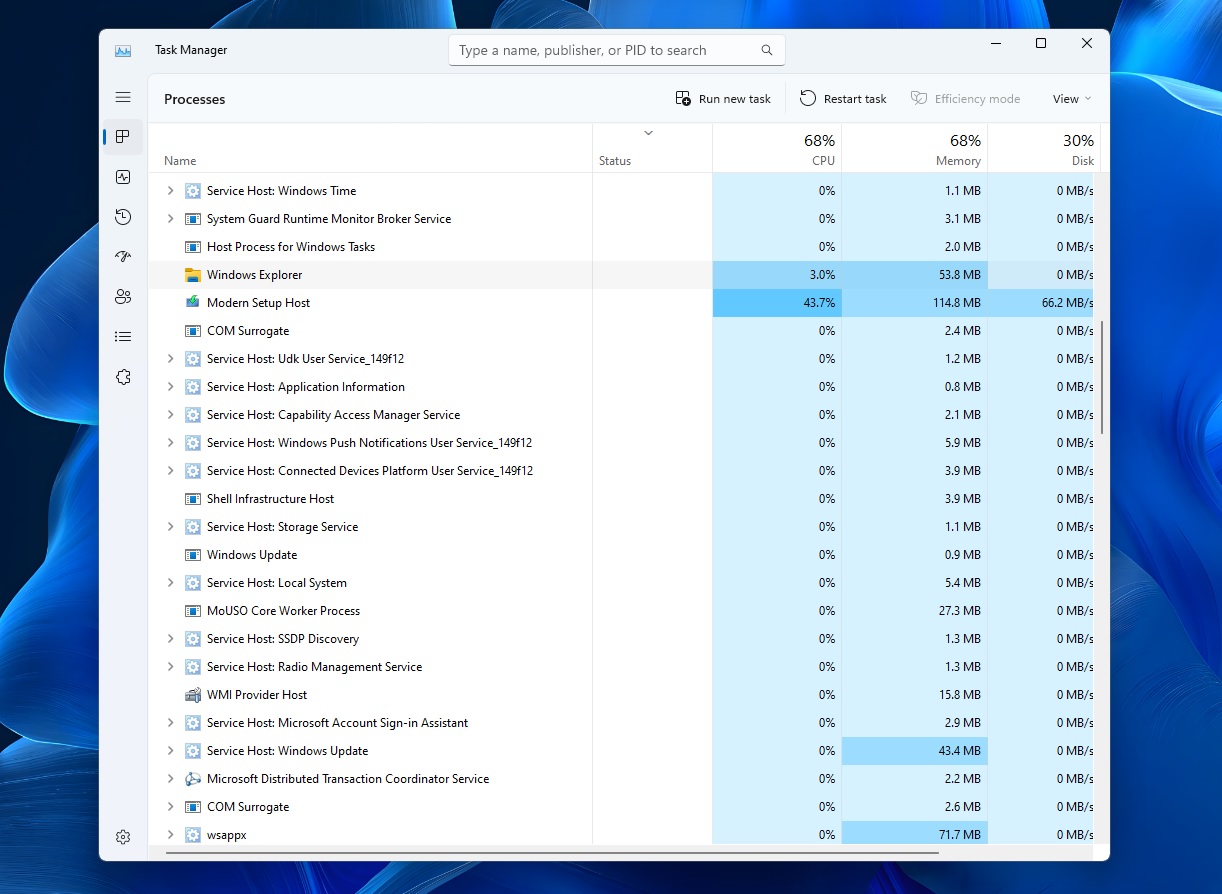
If you’re a long-time Windows user, you’re aware that several processes or features in the operating system are linked to File Explorer. While explorer.exe should be associated with file management only, it’s also associated with other parts of the Windows experience, like the Taskbar, which isn’t exactly a good thing for performance. Microsoft has been…
Microsoft wants to make Windows 11 faster by decoupling features from explorer.exe
At work, I have just migrated to Win11 and have noticed all the Windows Explorer weirdness everyone has documented since the release of the OS to the general public. No doubt all of this effort comes years after the run up to Windows95 when Explorer and Internet Explorer were turned into a Frankenstein’s monster hodge-podge of integration into the OS. Now MS is paying off the technical debt of adopt, embrace, extend of http, and browser tech integrated everywhere. Hopefully new bits of the OS will also migrate to the Rust language as well, and MS will become 10x more stable.
-
Time to plumb the depths of the Fediverse
Mastodon don’t fail me now! It’s that time, the time where people adopt the next big thing. Just like when I got my first FB account in 2005 and sat around waiting for the big wave to come in (2007) I had 1 half-hearted attempt at a Mastadon account, that I let go fallow. But then my brother joined, and picked a new server instance. So I started over and that was round about 2018. And there that account sat after an initial flurry of activity. But now, NOW things are shaking up again. And it feels like 2007 all over again where all the cool kids start dropping in and waves of people who swore they would never join, start coming in droves. Better late than never. So long Friendster, bye-bye MySpace, too-do-loo FB, sayonora Twitter. Hello Fediverse.
-
National Film Board – Universe (1960)

This film was so novel in it’s day people freaked out at how good it was. The production values were exemplary. No crappy animations, or amateurish attempts at lighting. No. This was space as rendered by Norman McLaren’s National Film Board. And that narration, the voice,… that gentle whispery voice of Canadian stage actor Douglas Rain.
This movie impressed NASA so much back in 1960 they bought a bunch of copies to keep on hand and distribute to people, even before JFK was elected, much less before he announced the Moon Program. It as THAT good. But guess who else noticed it? A young film maker named Stanley Kubrick. Look at ever frame. Pause, rewind and watch it again. Does it remind you of something? And that narrator,… Does that voice ring a bell? Well Kubrick took one look at this film and wrote down the names of all 3 guys who did the Special Effects and hired them (along with a young Douglas Trumbull) to make 2001: A Space Odyssey. And the voice actor, was hired to play HAL 9000. When you see this and realize Kubrick was obsessed and wanted to make his own version of this,… and wanted a kind of “open-ended” script from Arthur C. Clarke, he got everything he needed to whip something up. It just took forever to get it perfect. This film came out just 6 days prior to me being born. But it started some 8 years prior to that.
-
The rents are too-damned high: Shkreli-nomics writ large
From the Martin Shkreli school of product pricing, I give you RealPage: https://www.propublica.org/article/yieldstar-rent-increase-realpage-rent. More or less you can subscribe to this service and “anonymously” compare your tenant leases with others in your area. Therefore it’s “NOT” collusion, or price-fixing, or gouging. Let the algorithm do the work of raising the rents.
https://www.propublica.org/article/yieldstar-rent-increase-realpage-rent
-
OpenVerse what are you waiting for?!

Boeing SST Model Mounted in Ames 40×80 Foot Wind Tunnel, overhead view. May 31st,1965. Original from NASA. Digitally enhanced by rawpixel. by NASA is licensed under CC-CC0 1.0 Checkout Alan Levine’s blog, outlining the benefits of using OpenVerse for image searches.
Ditch Google Image search this very minute. They’ve given up, they don’t care. What’s cooler still is if you’re on a WordPress.com hosted site like me, you already can access OpenVerse from the Upload Image button in the Block editor. It shows up as a image website you can search and insert pictures from. I did it just now with the jet picture at the top, with full annotation/attribution/citation info in the caption. I didn’t lift a finger other than to search for “SST” then pick the coolest picture it showed in the results. It’s that easy.
-
Moral Injury Is an Invisible Epidemic That Affects Millions — Scientific American News
A specific kind of trauma results when a person’s core principles are violated during wartime or a pandemic
Moral Injury Is an Invisible Epidemic That Affects Millions — Scientific American NewsAnd Today I Learned – there’s a thing called “Moral Injury” which is separate and independent of PTSD. And it’s something that can be treated. Learning and reading about this, has brightened my day.
-
The iPhone 14 is the most repairable iPhone in years — AppleInsider News

While the iPhone 14 features aren’t hugely different from the iPhone 13, a teardown reveals Apple has made internal changes which make repairs easier.Below the iPhone 14 display [via iFixit]Apple doesn’t have the best reputation when it comes to enabling repairs. It has begrudgingly started to provide repair manuals and loans out tools to replace…
The iPhone 14 is the most repairable iPhone in years — AppleInsider NewsI give iFixit it full cred for looking at the “lesser” cousin to the iPhone 14 Pro to see what is inside. And it is vastly different as mentioned in their full YouTube update:
Sounds like a good deal of extra engineering went into routing antennas to the new full-span “mid-frame” where the torsional rigidity is now concentrated. Front/Rear panels are both user replaceable as far as I can tell. But getting Apple-certified parts and tools to repair are still being hampered by Apple. They are in a passive-aggressive battle internally to make their devices repairable by the owners of the devices, STILL it seems.
 Carpet Bomberz Inc.